LiveGood Review: Scam Or A Legitimate Path To Wealth ?
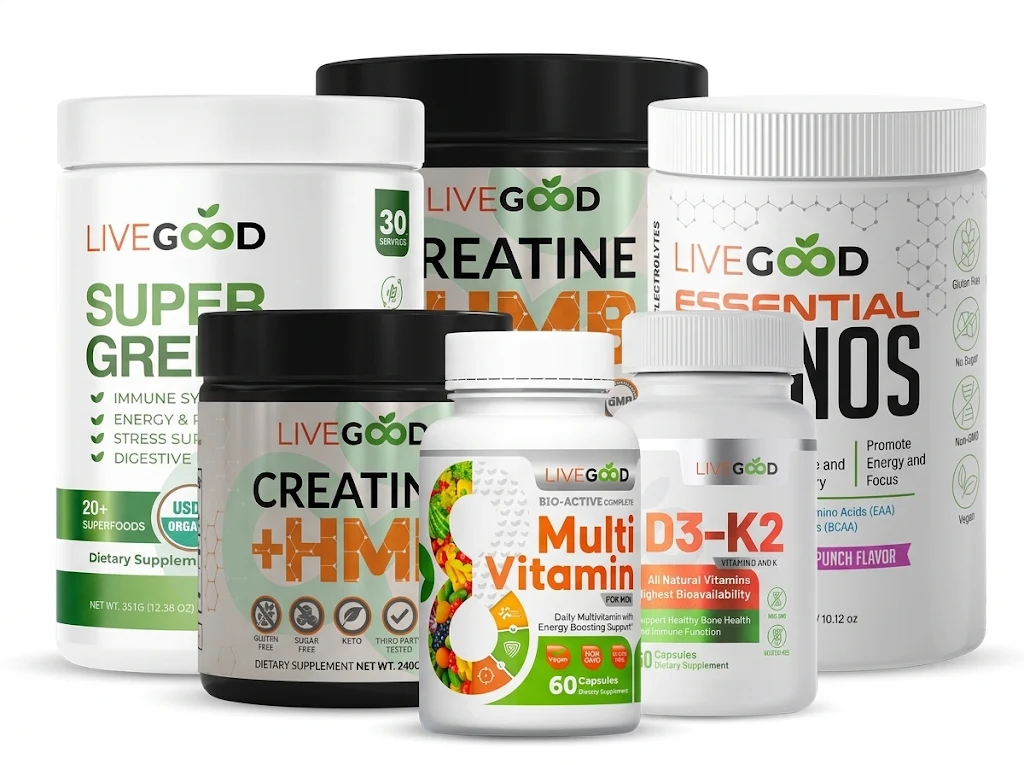
Table of Contents
A Former Affiliate Examines the Products, the $2,047 Income Claim, and the Mathematics Behind the Opportunity
Introduction: I Was a LiveGood Affiliate — Here’s What I Learned
I joined LiveGood while searching for ways to supplement my income online. I wrote this LiveGood review to detail my personal experience as an affiliate. At the time, I was working a full-time job, and the prospect of building an additional income stream was appealing.
I had sales experience, so I wasn’t intimidated by the idea of promoting products. But there was one problem: I’ve never particularly clicked with multi-level marketing (MLM).
Nevertheless, LiveGood caught my attention. The startup costs were relatively modest, the products appeared competitively priced, and the compensation plan offered the possibility of earning commissions through a system known as spillover.
Here’s what makes my experience interesting: I wasn’t particularly impressed with the business opportunity, but I genuinely liked several of the products.
In this review, I’ll examine both sides of LiveGood: the supplements, the compensation plan, the much-publicized $2,047 monthly income figure, and my own results as an affiliate.
1. LiveGood Review: What Is LiveGood, and How Does It Work?

LiveGood is a health and wellness company offering nutritional supplements through a membership-based business model.
Customers can purchase a membership for approximately $9.95 per month, which provides access to discounted product pricing. Individuals interested in promoting the company can also enroll as affiliates.
When I joined, the affiliate enrollment fee was $40, plus the monthly membership charge.
One of LiveGood’s selling points is its pricing. Some member prices are substantially lower than the advertised retail prices, although I occasionally questioned how those retail comparison prices were established.
Nevertheless, I found the actual member prices attractive.
For example, its men’s multivitamin was advertised at approximately $6.95 for members. Even allowing for the monthly membership fee, that could represent genuine value for someone purchasing multiple products regularly.
Of course, the economics change if you’re buying only one inexpensive supplement per month. The membership cost needs to be included when calculating your actual savings.
LiveGood Review: Who’s Behind LiveGood?

LiveGood publicly identifies its leadership team:
- Ben Glinsky: CEO
- Ryan Goodkin: Product Development
- Lisa Goodkin: Product Education
- Nauder Khazan: Field Development
Their names and backgrounds are available on the official LiveGood leadership page.
Transparency regarding company leadership? Check.
That doesn’t establish the quality of the products or the profitability of the affiliate opportunity, but publicly identifying the people responsible for operating the business is a positive.
2. LiveGood Review: Their Supplements – My Personal Experience
Here’s where LiveGood deserves some genuine credit.
During my time as an affiliate, I consistently used five of its supplements, and I was impressed with several of them.
I’ve had considerable personal experience with nutritional supplements over the years. I’ve tried products from numerous established brands, and I pay attention to ingredient combinations, formulations, ease of use, and price.
Bio-Active Men’s Multivitamin
I thought LiveGood’s men’s multivitamin offered an attractive combination of ingredients and pricing.
At approximately $6.95 for members, it compared favorably in price with many established alternatives.
Vitamin D3 + K2
I particularly appreciated the combination of vitamins D3 and K2.
Vitamin D supports calcium absorption, while vitamin K plays a role in normal calcium metabolism. Combining these nutrients is a formulation choice I appreciate, although the presence of both vitamins doesn’t automatically make a supplement superior or appropriate for everyone.
I was very pleased with this product.
Organic Super Greens
I’m sure the formulation appealed to people who enjoy powdered greens.
Unfortunately, to me it tasted like someone had combined wheatgrass juice with a generous helping of dirt!
And with the amount of coffee I consume, I wasn’t particularly interested in adding another powdered drink to my daily routine.
That was a matter of personal preference rather than a judgment about its nutritional quality.
Essential Amino Acid Powder
Now THIS was a product I loved.
I generally used the Lemon Lime flavor, although I also tried Fruit Punch.
Both reminded me of those sweet, fruity drinks we enjoyed as kids. The powder mixed effortlessly and had a slightly effervescent quality.
In terms of taste, mixability, and overall experience, I would happily compare LiveGood’s Essential Amino Acid Powder with products from nationally recognized supplement brands.
It was that good.
Creatine + HMB Powder
Another product that impressed me was LiveGood’s Creatine HMB powder.
The creatine was finely milled and mixed easily. Occasionally, a little sediment would collect if I didn’t drink it promptly, but another quick stir took care of that.
I also liked the inclusion of HMB, a compound studied for its potential role in muscle protein metabolism and preservation of muscle mass.
Research on HMB is interesting, although its benefits vary depending on the population, training conditions, and study design. Its inclusion alone doesn’t establish that a particular product improves muscle growth or recovery.
Still, I thought the formulation was worth examining.
My Wife’s Experience
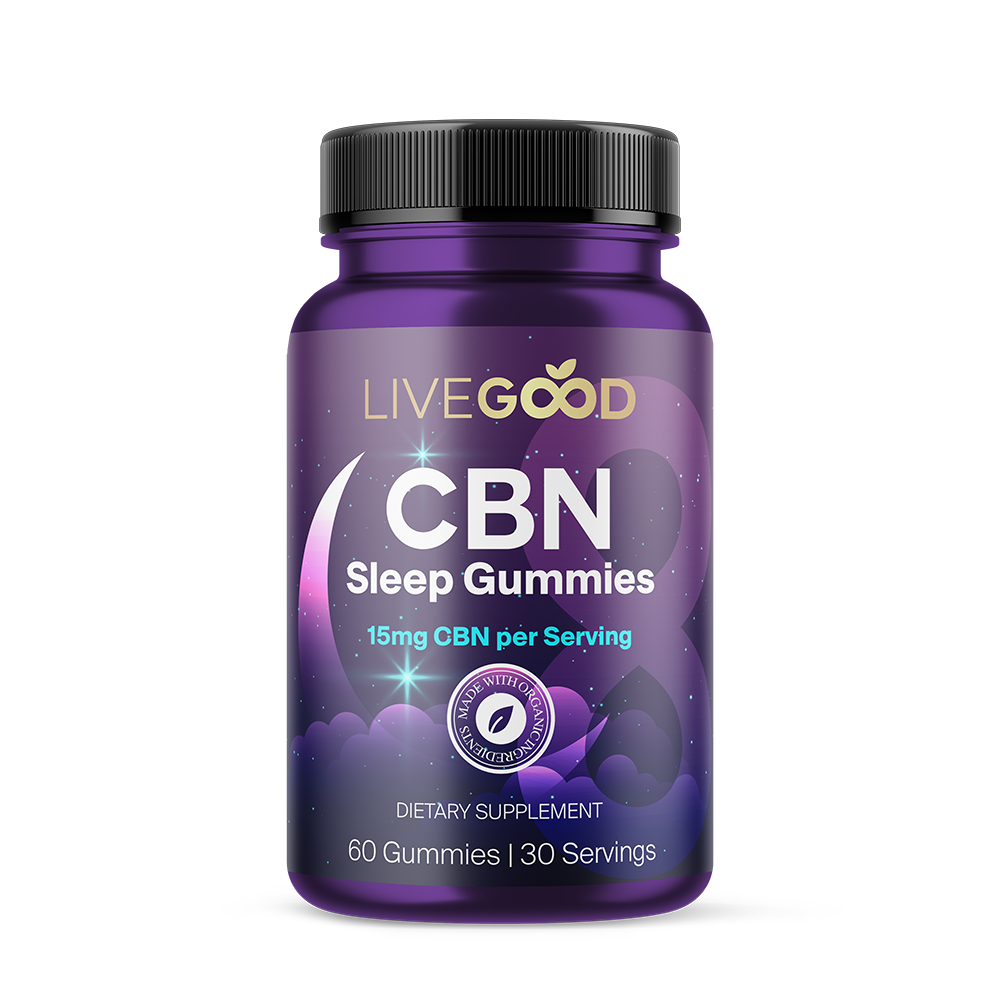
My wife also tried LiveGood’s nighttime gummies and liked them very much.
Her experience was positive, although, as with any supplement, individual results don’t establish clinical effectiveness.
My Overall Product Assessment
I came away believing that LiveGood had put considerable thought into several of its formulations.
I can’t independently verify the company’s research-and-development spending or manufacturing practices, but as a consumer, I was impressed by the combination of product features and price.
My opinion of the supplements remains favorable, even though I no longer participate in the affiliate business.
Health disclaimer: I am not a physician, registered dietitian, or other licensed healthcare professional. These comments reflect my personal experiences and opinions, not medical advice or scientific proof of effectiveness. Consult an appropriate healthcare professional before beginning a supplement regimen, particularly if you take medication or have an existing health condition.
3. LiveGood Review: My Experience as an Affiliate

My introduction to LiveGood came through a friend.
I had asked him about possible online income opportunities. He suggested two ideas: writing eBooks and joining LiveGood.
I passed on the eBook idea and decided to investigate LiveGood.
I paid the enrollment and membership fees, but for the first few months, I didn’t do much with the business.
After approximately three months of paying the $9.95 membership fee, I finally told myself:
You might as well get something out of this. Their prices look good. Let’s try the products.
I’m glad I did.
Later, through my involvement with Send It Academy, I encountered someone promoting a LiveGood group and decided to give the business another try.
This time, I made a genuine effort.
I posted regularly on Facebook and Instagram. I used LeadsLeap, classified-ad submissions, and even Craigslist advertisements in several major American cities.
I spent roughly an hour a day promoting the opportunity over approximately four months.
Now, I understand that building a business takes time. Four months is hardly enough to establish a mature enterprise, and many legitimate ventures require considerably longer before producing meaningful returns.
But I was looking for some indication that my efforts were gaining traction.
I received two responses through Meta.
The first asked:
“How’s LiveGood going?”
The second said:
“Tried it. Didn’t work.”
Not exactly the response I’d envisioned!
I enrolled my wife and briefly considered enrolling our Golden Retriever, Logan.
Fortunately, I bowed out before that happened.
Or should I say I bow-wowed out?
All joking aside, I earned nothing from the venture and estimate that I spent approximately $400–$500 promoting it, in addition to membership-related costs.
I also received no meaningful training or personal guidance from my sponsor.
Perhaps other affiliates receive excellent support from their uplines. I can only speak to my own experience.
I’m just glad that I found my home. I am an affiliate with Justin Temple’s HighTicketLifestyle. HTL is simple, straightforward and gives me more support than I could imagine.
Visit now to start tapping into multiple streams of income.
The bigger lesson was that I already knew I wasn’t particularly enthusiastic about MLM. I should have recognized that my lack of enthusiasm for the business model itself would be a substantial obstacle.
One of my more successful promotional posts received approximately 38 views. I may originally have obtained the creative from another offer, but I used it to promote LiveGood.
That experience helped convince me to discontinue my planned marketing campaign.
4. How Does LiveGood’s Affiliate Compensation Plan Work?
LiveGood’s compensation structure includes several potential sources of affiliate income.
Fast Start Commissions
Under the plan I reviewed, a qualifying new affiliate and member enrollment could generate a combined $25 Fast Start commission: $20 associated with the affiliate enrollment and $5 associated with the membership.
Actual eligibility depends on the compensation-plan terms.
Monthly Matrix Commissions
LiveGood uses a two-wide matrix extending up to 15 levels deep.
The matrix can include people you personally enroll and individuals placed beneath you through the organization’s structure.
Commission eligibility varies by rank and qualifying activity.
Matching Bonuses
The plan also describes matching bonuses based on the matrix commissions earned by personally enrolled affiliates, with additional opportunities potentially available at higher ranks.
Rank Advancement
LiveGood’s ranks include Bronze, Silver, Gold, Platinum, Diamond, and higher levels.
Advancement generally requires increasingly substantial qualifying organizations, personal enrollments, and other conditions.
The complete requirements should be reviewed directly in the company’s official rank qualifications.
Confused yet?
Don’t worry. The next section is where the mathematics becomes particularly interesting.
5. The Famous $2,047 Monthly Income Claim: Let’s Do the Math
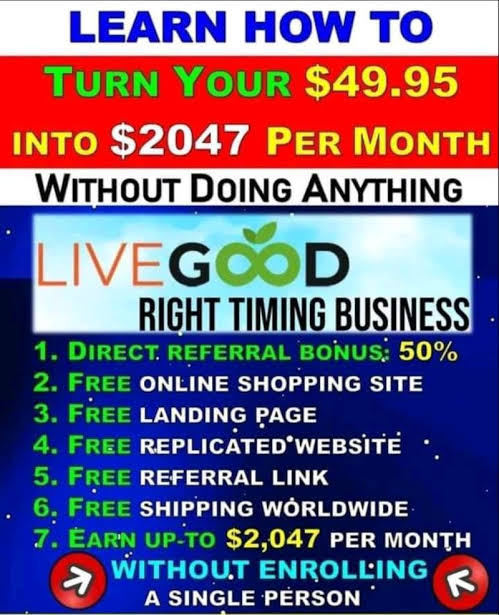
One of the most attention-grabbing claims associated with LiveGood is the possibility of earning $2,047.50 per month without personally recruiting anyone.
How does that work?
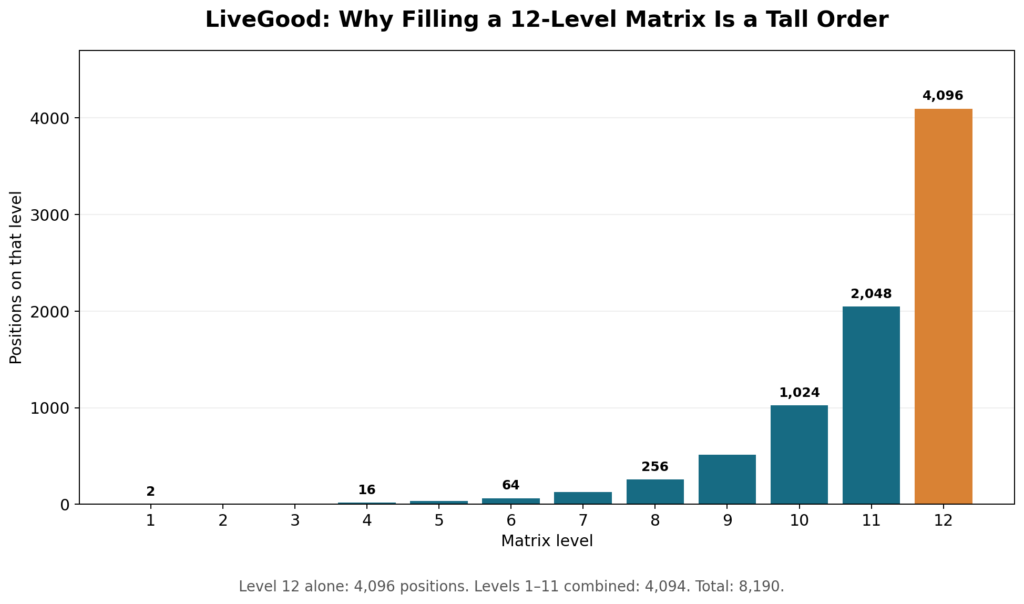
The advertised figure is based on a fully populated, qualifying 12-level, two-wide matrix.
Each level contains twice as many positions as the preceding level.
The first level has two positions, the second has four, the third has eight, and so on.
By the twelfth level, there are 4,096 positions on that level alone.
Add all 12 levels together and you get:
8,190 positions.
At a commission rate of $0.25 per qualifying active position:
8,190 × $0.25 = $2,047.50 per month.
The arithmetic is straightforward.
Filling and maintaining that matrix is another matter entirely.
Possible Income Versus Probable Income
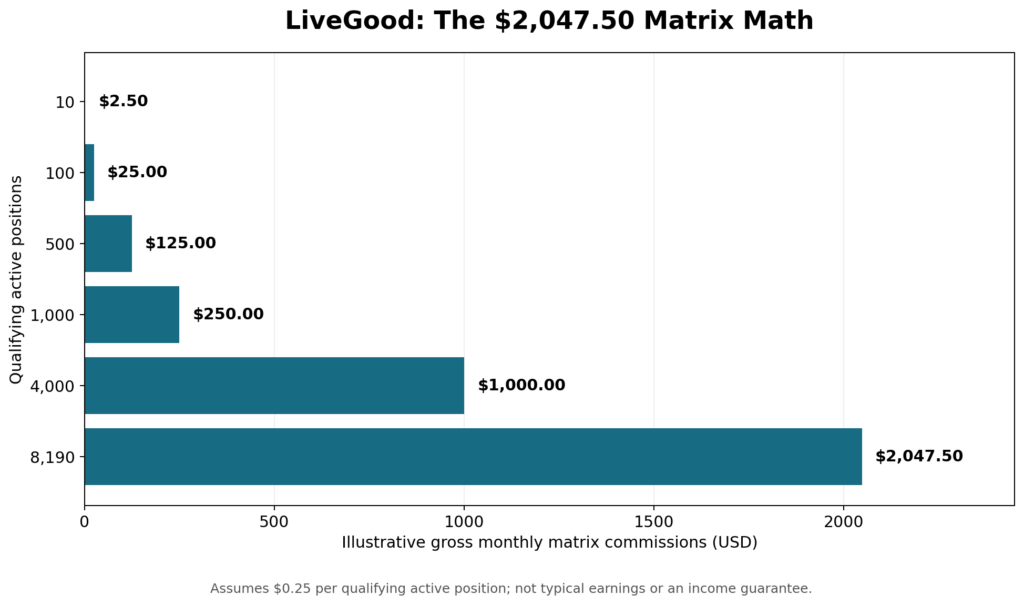
| Qualifying active positions | Illustrative monthly income |
|---|---|
| 10 | $2.50 |
| 100 | $25.00 |
| 500 | $125.00 |
| 1,000 | $250.00 |
| 4,000 | $1,000.00 |
| 8,190 | $2,047.50 |
These are illustrative gross calculations, not verified average affiliate earnings.
And that distinction matters enormously.
A theoretical maximum tells us what a compensation structure can pay under certain conditions.
It does not tell us how frequently participants achieve that result.
6. The Spillover Promise: MLM’s Version of Trickle-Down Economics?
One of LiveGood’s most intriguing marketing concepts is something called spillover.
In a forced matrix, the number of positions on your first level is limited.
When additional members enter an organization, some may be placed in positions beneath existing affiliates.
In theory, this means an affiliate could receive matrix commissions from people they didn’t personally recruit.
Sounds attractive, doesn’t it?
But consider the numbers.
A complete 12-level matrix contains 8,190 positions. Of those, 4,096 are on the twelfth level.
In other words, the final level contains more positions than the preceding eleven levels combined.
That’s exponential growth.
Spillover may occur, but its existence doesn’t guarantee that a particular affiliate will receive enough qualifying placements to generate meaningful income.
Nor does the matrix’s mathematical structure tell us the probability of reaching the advertised maximum.
For that, we’d need reliable data showing what participants actually earn.
In my experience, the spillover concept was an enticing promotional hook.
But I didn’t experience meaningful financial results from it.
Does that mean nobody benefits from spillover?
Of course not.
It means I would want considerably more evidence before treating spillover as a dependable income strategy.
Big take away from all of this is that I learned to keep things simple and dependable. Home Business Academy offers me all the tools I need to succeed in affiliate and digital marketing. HBA can have your system up and running in minutes – yes minutes try HBA today. Start turning your hard earned leads into sales.
7. The Recruitment Ladder: Bronze, Silver, Gold, and Beyond
Another important consideration is the difference between joining an opportunity and advancing through its compensation structure.
At the entry level, participation may require relatively little money.
But higher ranks involve increasingly substantial organizational qualifications.
That generally means recruiting, supporting, and retaining a larger network of active members and affiliates.
And retaining participants can be just as important as enrolling them.
People cancel subscriptions. Affiliates lose interest. Customers change their purchasing habits.
Those realities affect the ongoing commission potential of any network marketing organization.
The question prospective affiliates should ask isn’t merely:
How much can the highest-ranking participants earn?
8. LiveGood Review: In 2026, Is It Oversaturated or Played Out ?
What does it take to build and maintain an organization that produces meaningful net income?
LiveGood has experienced considerable growth since its launch.
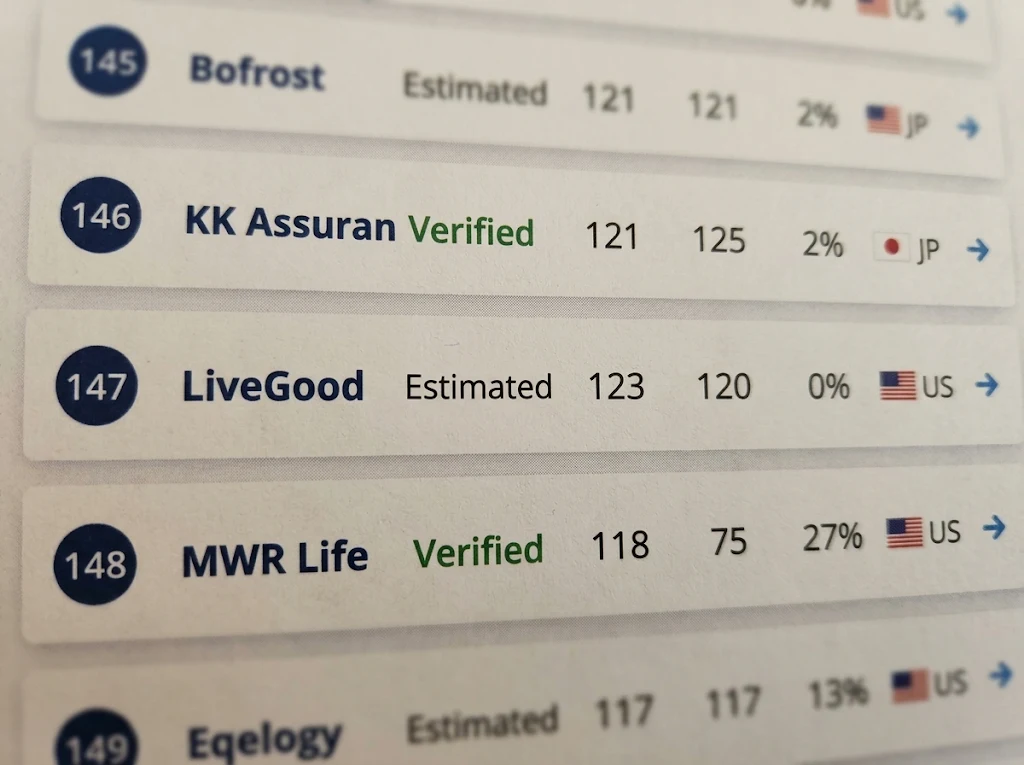
Business For Home’s 2026 global direct-selling directory reportedly places LiveGood at approximately #148, with estimated annual revenue around $120 million.
Promotional sources have also cited cumulative membership and affiliate figures exceeding 2.4 million worldwide.
Those numbers suggest that LiveGood has achieved substantial reach.
But they don’t necessarily tell us how many members are currently active, how many are paying recurring fees, or how many affiliates are earning meaningful commissions.
And that raises an important question.
Can a company remain commercially successful while becoming increasingly difficult for new affiliates to promote?
Absolutely.
A large established customer base may be good news for the company. But a crowded promotional environment can make it more difficult for newcomers to attract attention.
I encountered that challenge firsthand.
Despite consistent promotional activity, I struggled to generate even basic inquiries.
Today, I get my share of inquiries and when I do, I count on AWeber to secure those leads and respond to them
promptly and professionally. Click here to take advantage of AWeber’s free introductory offer !
That doesn’t prove the entire market is saturated. But it certainly influenced my decision to stop promoting the opportunity.
A company’s continuing existence and its attractiveness as a new business opportunity are two different questions.
9. LiveGood’s Earnings Claims and Regulatory Scrutiny
LiveGood’s promotional earnings representations have attracted attention from the Direct Selling Self-Regulatory Council (DSSRC), administered by BBB National Programs.
The council reviewed earnings-related advertising claims associated with LiveGood in 2024 and 2025, including representations involving substantial income opportunities.
Its recommendations concerning unsupported promotional claims deserve consideration.
Importantly, an advertising self-regulatory review is not the same thing as a court finding that a company is fraudulent or operating an illegal pyramid scheme.
But it does reinforce a basic principle:
Extraordinary income claims require meaningful substantiation.
Consider an advertisement I reposted during my time promoting LiveGood.
It described a formerly homeless man who supposedly became a millionaire within a year and was receiving $80,000 per month in residual income.
That’s $960,000 annually.
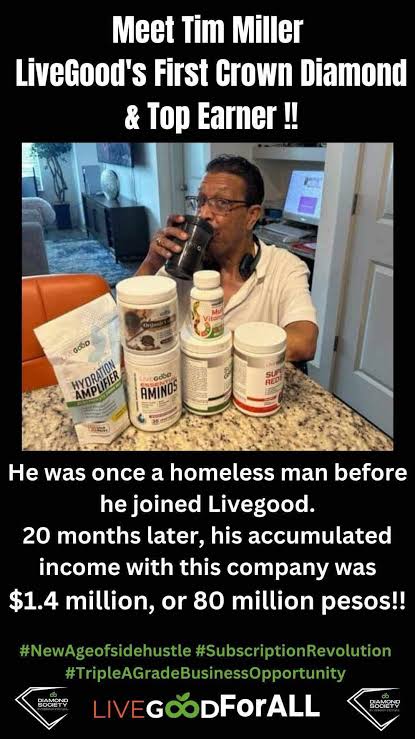
Was the story true?
I don’t know. I’d love to believe it.
But I can tell you something: the advertisement was compelling enough that I shared it.
Looking back, I recognize that an extraordinary success story—even if entirely genuine—tells us very little about what the average participant can realistically expect.
It’s the difference between an effective marketing hook and a reliable earnings forecast.
10. LiveGood Pros and Cons
What I Like
- Relatively low initial affiliate enrollment costs.
- Several supplements I genuinely enjoyed using.
- Competitive member pricing on certain products.
- Publicly identified company leadership.
- A published compensation structure.
- The ability to purchase products without actively building an affiliate organization.
What Concerns Me
- The gap between theoretical earnings and realistic expectations.
- The importance of recruitment and organizational growth for substantial commissions.
- Limited reliable information about typical affiliate earnings.
- Recurring membership costs.
- Competition among affiliates promoting the same opportunity.
- Historical earnings claims questioned through advertising self-regulation.
- My own disappointing promotional results and lack of sponsor support.
11. LiveGood Review: Final Verdict: Scam or a Legitimate Path to Wealth?
Here’s where I land.
The products? I think several are excellent.
I used them, enjoyed them, and found some of their formulations and prices impressive.
I have no reason to pretend otherwise simply because I didn’t succeed as an affiliate.
The income opportunity? Personally, I’d take a pass.
I invested time and money, received little support, and failed to generate meaningful interest.
I also found the spillover proposition considerably less persuasive once I examined the mathematics behind the advertised income figures.
That doesn’t establish that nobody succeeds with LiveGood.
It certainly doesn’t establish that the company is a scam.
But I wouldn’t recommend joining on the assumption that spillover will create substantial passive income without significant effort or favorable circumstances.
For me, the consumer proposition was considerably more attractive than the affiliate opportunity.
12. Final Thoughts: What I’d Tell Someone Considering LiveGood Today
If you’re considering LiveGood primarily for its supplements, compare the ingredients, quantities, member prices, and recurring membership fee against alternatives.
You may find genuine value.
If you’re considering joining as an affiliate, approach the opportunity differently.
To keep myself informed of what opportunities to examine and which ones to run from, I turn to Badass Network. Badass Network gives me the opportunity to publish my blog as well
as read reviews of more seasoned affilates and online marketers. Click now and see for yourself how easy they’ve made it for us to blog and most importantly to get seen.
Study the compensation plan. Ask for reliable information about typical earnings. Calculate your ongoing costs, and be realistic about the time required to recruit and retain customers.
Most importantly, distinguish between what is mathematically possible and what is reasonably probable.
That’s a lesson I learned firsthand.
And sometimes, knowing when to walk away from a business opportunity is just as valuable as knowing when to pursue one.
Disclosures
Affiliate relationship: I previously participated as a LiveGood affiliate. This review reflects my personal experiences and opinions. Any current affiliate relationships or compensation arrangements associated with links in the final article will be disclosed.
Health information: I am not a licensed healthcare professional. My product observations are anecdotal and should not be interpreted as medical advice or evidence of clinical effectiveness.
Earnings information: The commission examples are illustrative gross calculations, not typical earnings estimates or guarantees. Individual results depend on qualification requirements, member activity, expenses, and other factors.