How to Make Money From Your Hobby: A Practical Beginner’s Guide
Table of Contents
Three People. Three Dreams
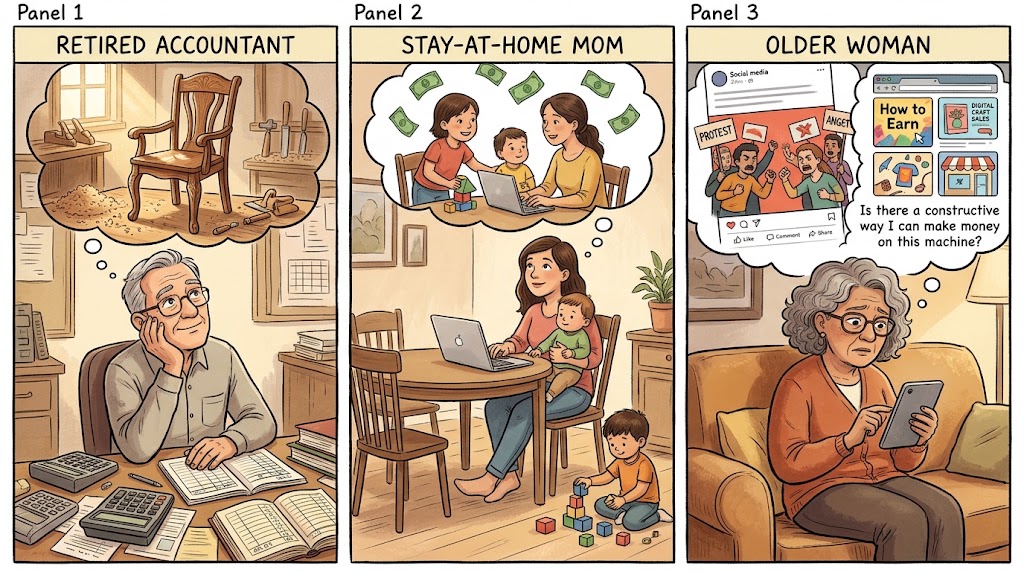
Somewhere right now, a retired accountant is wondering whether his woodworking hobby could earn him a few extra dollars.
A stay-at-home mother is searching for ways to contribute financially without sacrificing time with her children.
And someone approaching retirement is wondering whether the internet offers opportunities beyond watching videos and arguing with strangers on Facebook.
Three different people. Three different circumstances. One question:
“Is there a realistic way to make money online or from home?”
The answer is yes. But the more useful question is how to get started without wasting time, money, or enthusiasm.
And here’s something that might surprise you.
You don’t necessarily need a website, an expensive business course, or a sophisticated marketing campaign to begin.
You might already have something people are willing to pay for.
It’s called your hobby.
How to Make Money From Your Hobby Without Spending a Fortune
Let’s get one thing out of the way.
You don’t have to become the next Jeff Bezos to make a few extra dollars doing something you enjoy.
In fact, one of the biggest mistakes aspiring entrepreneurs make is spending money preparing to make money.
They purchase software, design elaborate websites, order business cards, and spend weeks deciding what to call their new enterprise.
There’s just one little problem.
They haven’t found a customer yet.
My suggestion? Start by identifying something you enjoy doing that solves a problem people are already paying someone else to solve.
Validate the demand before investing heavily in the business.
Naturally, certain activities require licenses, permits, insurance, or other protections before you begin. We’ll get to that.
But there’s no reason to build an expensive marketing operation before determining whether anyone wants what you’re offering.
Now hear me out, if at the moment you’re stumped and can’t think of anything off the top of your head. We got you !! I participate in HighTicketLifestyle (HTL )
HTL was founded and is run by Justin Temple. Justin has years of experience in the Making Money Online niche and has devised a program that allows regular people
to get started in the field of affiliate and digital marketing. His program is simple and extremely well thought out giving people that want to put in a little time and effort
a chance to tap into multiple streams of income. Justin is very knowledgable and helpful. He truly loves the business and shares enthusiastically. Give yourself the chance now https://thehighticketlifestyle.com/danielo
HighTicketLifestyle may be able to give you the answer to home income that you’ve been searching for.
Step 1: Find a Hobby People Will Actually Pay You For

When considering how to make money from your hobby, start with a simple question:
What do people already spend money on that I enjoy doing?
Let’s explore a few possibilities.
Pet Sitting and Dog Walking
Are you an animal lover?
Dog walking could be a natural starting point.
People work long hours, travel, become ill, or simply need someone reliable to help care for their pets.
And dog walking isn’t necessarily pocket change.
Consider some advertised rates I found while researching this article:
- New York City: Approximately $22 for a half-hour walk and $35 for an hour.
- Mobile, Alabama: Individual advertised services ranging from $15 for a short visit to $24 for an hour.
- Huntington Beach, California: Approximately $20–$26 for 30 minutes, with some hour-long services advertised between $34 and $60.
These are examples of advertised prices, not guaranteed earnings or citywide averages. Prices depend on the provider, services, location, and length of the visit.
But they demonstrate something important.
People are already spending money on these services.
And don’t forget cat sitting.
When someone goes away, somebody has to feed Kitty, change the litter, and provide a little companionship.
The same applies to birds, fish, reptiles, and other household pets.
Of course, caring for somebody’s animals is a responsibility. Experience, reliability, appropriate insurance, and an understanding of animal behavior matter.
But for the right person, this could be an enjoyable way to earn supplemental income.
Fitness, Boxing, and Martial Arts
Perhaps you’ve spent years practicing boxing, martial arts, or another form of exercise.
Why not explore whether others would pay to learn what you know?
Not everybody enjoys spending an hour walking on a treadmill or grinding away on an elliptical machine.
Some people want something different.
Boxing fundamentals, beginner martial arts instruction, or specialized fitness sessions might appeal to people who are bored with conventional exercise.
You should have the appropriate qualifications, safety procedures, and insurance before offering physical instruction.
But the basic principle remains the same.
Your experience may have value to somebody else.
Hairdressing, Makeup, and Personal Services
Here’s another possibility.
Are you a licensed hairdresser or cosmetologist?
Consider whether providing services in clients’ homes is permitted where you live.
My wife and I live in a gated 55+ community.
Believe me, someone offering convenient, reliable personal services could find an interested audience here!
People appreciate convenience, particularly those who have difficulty traveling.
And what about makeup artistry?
Weddings, proms, Bat Mitzvahs, and Quinceañeras all create demand for professional makeup services.
One caution: Before offering in-home services, check licensing requirements, insurance coverage, and personal safety considerations.
Convenience is wonderful.
Getting yourself into a situation you shouldn’t be in? Not so wonderful.
Step 2: Turn Collecting and Vintage Hobbies Into Extra Income

Here’s one for my fellow Boomers.
Remember the original Bullworker?
I’m talking about the vintage exercise device, not the various modern versions.
What about Iron Shoes or Iron Boots, those old-fashioned weight-training contraptions?
If you grew up around bodybuilding equipment in the 1960s and 1970s, you probably know exactly what I’m talking about.
While researching, I came across a pair of vintage Iron Shoes advertised on eBay for $75.
Now, an asking price isn’t necessarily what an item will sell for. Checking completed sales is a much better way to estimate market value.
But it illustrates the opportunity.
People collect all sorts of things.
Vintage records, old exercise equipment, cameras, toys, tools, and memorabilia can attract buyers.
Something that’s been sitting in your garage for 40 years might be exactly what a collector has been searching for.
Before selling, research comparable items, condition, shipping expenses, and selling fees.
And don’t overlook the satisfaction of giving an old possession a new home.
Sometimes making money from your hobby begins with discovering that your clutter is somebody else’s treasure.
Step 3: Find Your First Customers Without Paying for Advertising
Here’s where many people overcomplicate things.
You don’t need thousands of social media followers to find your first customer.
Start with people you already know.
Friends, family, former coworkers, and neighbors can be excellent sources of referrals.
Tell them what you’re offering.
You might say:
“I’m starting a little dog-walking service in the neighborhood. If you know anyone who needs a reliable person to walk their dog, I’d appreciate you passing my name along.”
Simple.
No elaborate sales pitch.
No promises of financial freedom.
Just one person offering something useful to another.
From there, explore community resources.
Nextdoor, local Facebook groups, community bulletin boards, and neighborhood newsletters may help you reach potential customers.
Some supermarkets, libraries, and community centers still maintain bulletin boards.
Imagine that.
A marketing method that doesn’t require learning another password!
Before posting, check each platform’s rules. Some services, such as Facebook Marketplace, restrict certain service listings.
The important thing is to make your offer clear, practical, and easy to understand.
Step 4: Make Getting Paid Simple and Professional
Once you’ve found someone interested in your hobby-based service, make the transaction straightforward.
Depending on the type of business, customers may appreciate familiar payment methods such as PayPal, Venmo, or Zelle.
Cash can also be perfectly acceptable.
However, use the appropriate business payment features when required, verify payments independently, and never assume that a screenshot proves money has arrived.
Keep records of your income and expenses from the beginning.
You don’t need a complicated accounting department.
A simple spreadsheet may be sufficient for a very small operation.
Also, make your payment terms clear.
Will customers pay when booking, after the service, or when receiving an item?
Will you require a deposit?
What happens if someone cancels?
These details help prevent misunderstandings.
And here’s an old-fashioned marketing technique that still works.
Ask satisfied customers for referrals.
You might even offer a modest discount on a future service when a referral becomes a paying customer.
Good service creates happy customers.
Happy customers tell other people.
That’s how many successful businesses get started.
Step 5: Turn Your Hobby Into a Business With a Partner
Good friends are hard to find.
A good business partner?
Sometimes even harder!
But imagine this situation.
You have a friend who loves ballroom dancing.
They’re an excellent dancer, a patient instructor, and someone people genuinely enjoy learning from.
Unfortunately, their technical skills stop somewhere around turning on the computer.
Meanwhile, you understand social media, online advertising, or basic digital marketing.
See where I’m going?
Your friend provides the expertise.
You help introduce that expertise to a wider audience.
Together, you may be able to create something neither of you could easily accomplish alone.
This approach can work with photographers, artists, musicians, craftspeople, and countless other hobbyists.
Before beginning, agree on responsibilities, expenses, compensation, and how either person can leave the arrangement.
A written agreement can prevent a promising business partnership from becoming an expensive friendship-ending experience.
Step 6: Don’t Put the Business Cart Before the Horse
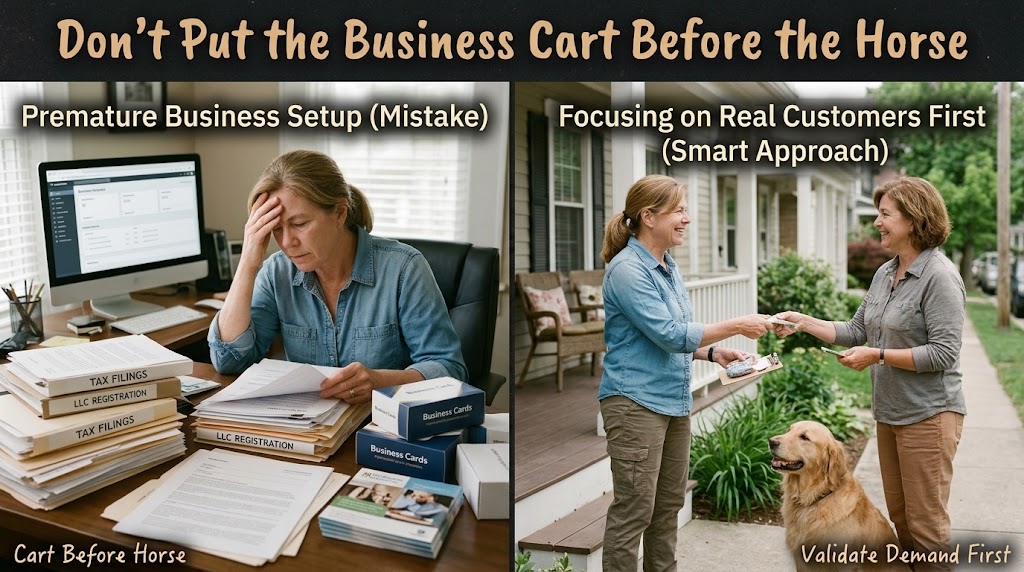
Here’s a lesson I learned the hard way.
Years ago, I started one of my first businesses.
Like many enthusiastic beginners, I listened to an entrepreneurial guru who convinced me that I needed to establish all sorts of business infrastructure before getting started.
So I did.
Business paperwork. Tax registrations. Administrative obligations.
The whole production.
And how much money did I make?
About $500.
That’s right.
Five hundred dollars.
I spent more time dealing with administrative headaches than earning money!
I call experiences like that my tuition fees.
Every entrepreneur pays them sooner or later.
The trick is learning something valuable without paying too much tuition.
Now, I want to make an important distinction.
I’m not suggesting that anyone ignore tax laws, licensing requirements, or legitimate business obligations.
Even a small side business can generate taxable income. Certain occupations require permits or licenses before accepting the first customer.
And an LLC isn’t automatically necessary for every small business, although liability protection may be worth considering.
My point is simply this:
Don’t confuse spending money on a business with building a business.
Learn which requirements apply to your activity, satisfy them, and avoid unnecessary expenses until you’ve demonstrated real customer demand.
There’s no trophy for having the fanciest business cards and an empty appointment book.
Step 7: Build an Online Presence When You’re Ready to Grow
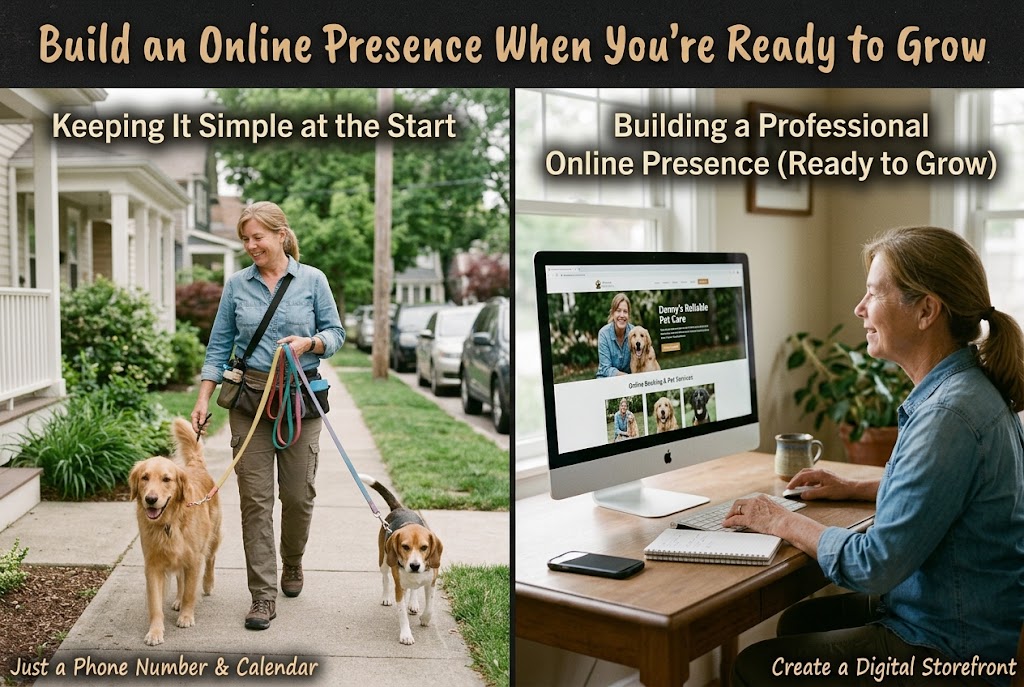
Suppose you’ve been walking dogs, teaching photography, or selling vintage collectibles for a few months.
You’ve developed some customers.
People are recommending you.
Now you’re wondering how to turn your hobby into a more established business.
This is where digital marketing tools can become useful.
A website or landing page can give prospective customers one convenient place to learn about your services, see examples of your work, and contact you.
Think of it as a virtual storefront.
One platform worth exploring is Home Business Academy (HBA).
HBA offers a funnel-building platform designed to help users create landing pages, capture leads, and develop online marketing systems.
For someone interested in expanding beyond personal referrals, these capabilities may be useful.
That doesn’t mean everybody needs a sales funnel.
If you’re walking three dogs a week and you’re perfectly happy doing that, you may not need anything more sophisticated than a phone number and a reliable calendar.
But if your ambitions grow, learning how to create a more professional online presence may be a sensible next step.
Go and click https://thehba.app/go?aff_id=18946 to get your site up and running
Step 8: Build Customer Relationships With Email Marketing
Let’s say your hobby business begins attracting regular inquiries.
Someone wants to know about your photography services.
Another person asks whether you’re available for a particular event.
A third wants information about future classes.
Suddenly, keeping track of everyone becomes a challenge.
This is where an email marketing platform can help.
AWeber offers tools for managing subscribers, creating email campaigns, and automating follow-up messages.
For example, a photography instructor could invite interested people to subscribe for information about upcoming workshops.
A craft seller might notify subscribers when new products become available.
A fitness instructor could share schedules, announcements, and educational content.
The goal isn’t to bombard people with advertisements.
It’s to build relationships with people who have expressed a genuine interest in what you offer.
Always obtain appropriate permission before adding someone to a marketing email list, and provide a straightforward way to unsubscribe.
To make sure you don’t lose valuable leads and get back to them quickly and professionally click http://www.aweber.com/easy-email.htm?id=562049 to get help from their team right now.
Step 9: Use Blogging to Give Your Hobby Business a Voice
One of my favorite ways to communicate with potential customers is through blogging.
Why?
Because a blog allows you to explain what you do, share your experience, and answer questions people are already asking.
Let’s return to our retired accountant who loves woodworking.
Imagine he publishes an article titled:
“Five Mistakes Beginners Make When Restoring Antique Furniture.”
He’s not simply advertising furniture restoration.
He’s demonstrating what he knows.
Someone searching for advice may discover his article, appreciate his expertise, and eventually become a customer.
That’s the value of useful content.
For my own blogging, I use Badass Network.
See my article : Customer-Centered Marketing. When Storytelling Goes Too Far https://badassnetwork.com/destinymethod4u/customer-centered-marketing/
It provides a blogging platform that allows me to publish articles, share ideas, and develop my Destiny Method 4u brand.
I’ve found it useful for organizing my content and communicating with readers.
Blogging isn’t a guarantee of traffic or sales. Building an audience requires useful material, consistency, and patience.
But it can provide something that a fleeting social media post often cannot:
A permanent home for your ideas.
Badass Network affords me the opportunity to reach a wide variety of potential buyers. See for yourself by visiting https://badassnetwork.com/go/dino4051/ today. Get your message out there so people can see.
Step 10: Choose the Right Social Media Platforms for Your Hobby
Here’s another mistake people make.
They decide to start a business and immediately conclude that they need to be everywhere.
Facebook.
Instagram.
TikTok.
YouTube.
LinkedIn.
Pinterest.
And whatever new platform somebody invents next Tuesday.
Before long, they’re spending more time managing social media accounts than enjoying the hobby that inspired the business.
There’s a better approach.
Go where your potential customers already spend their time.
If you’re a photographer, Instagram may be an excellent place to showcase your work.
If you make handcrafted jewelry, Etsy might provide access to people already shopping for unique products.
If you collect and resell vintage exercise equipment, eBay or Facebook Marketplace could be worth exploring.
And if you enjoy creating imaginative short videos using AI-generated images, YouTube Shorts and TikTok may be natural places to experiment.
I know someone who enjoys making those kinds of videos, and some of the results are genuinely delightful.
The point isn’t to master every platform.
It’s to identify one or two that fit your hobby, your audience, and your available time.
Then learn to use them effectively.
Step 11: Decide How Much You Really Want Your Hobby Business to Grow
There’s something important that often gets overlooked in discussions about making money from a hobby.
Not every hobby needs to become a full-time business.
Maybe you enjoy woodworking because it relaxes you.
Perhaps you love photography because it gives you an excuse to explore new places.
Or maybe you enjoy walking dogs because spending time with animals makes you happy.
What happens when your relaxing hobby becomes a business with appointments, deadlines, customer complaints, and bookkeeping?
Suddenly, that peaceful afternoon in the workshop doesn’t seem quite so peaceful.
You’ve got three customers waiting for their orders.
One wants a discount.
Another wants to know why you haven’t answered an email.
And somebody else wants to return a custom-made rocking chair because it doesn’t match the curtains.
Congratulations!
You’re an entrepreneur.
Before expanding, ask yourself a few questions.
How much additional income would genuinely improve my life?
How many hours am I willing to devote to this?
Do I want employees, contractors, and administrative responsibilities?
Or would I be perfectly content earning a few hundred dollars a month doing something I enjoy?
There’s no universally correct answer.
For some people, a hobby becomes a thriving business.
For others, it remains a pleasant source of supplemental income.
And some people discover that they would rather keep their hobby exactly what it was.
A hobby.
Final Thoughts: Make Money From Your Hobby Without Losing the Joy

If you’ve been wondering how to make money from your hobby, remember that you don’t have to build an empire.
You don’t need to quit your job, mortgage your house, or spend thousands of dollars on business systems before finding your first customer.
Start with something you know.
Find people who need it.
Offer genuine value.
Keep your expenses reasonable.
And if the opportunity grows, explore the tools and resources that can help you manage that growth.
Most importantly, decide what success means to you.
For one person, it might mean replacing a full-time salary.
For another, it might mean earning enough extra money to take a vacation, help with household expenses, or enjoy a few additional comforts in retirement.
Both are legitimate goals.
Just remember one thing.
Before turning your favorite hobby into a business, ask yourself whether you’re still going to enjoy doing it when somebody else is paying you.
Because once you’re responsible for customers, budgets, schedules, and all the other obligations that come with running a business…
Heavy is the head that wears the crown.
And sometimes, my friend, it’s nice just to make a rocking chair.
Affiliate Disclosure: Some links in this article may be affiliate links. If you purchase through them, I may earn a commission at no additional cost to you. I recommend evaluating each product or service according to your own needs, goals, and budget.
About Destiny Method 4u
Destiny Method 4u explores practical approaches to affiliate marketing, digital business, and creating new opportunities without unrealistic promises or unnecessary hype.
No hype. Just the life I enjoy.