You Don’t Have a Traffic Problem: Why Pinterest Impressions Are High but No Sales (And What Top Affiliates Do Differently)
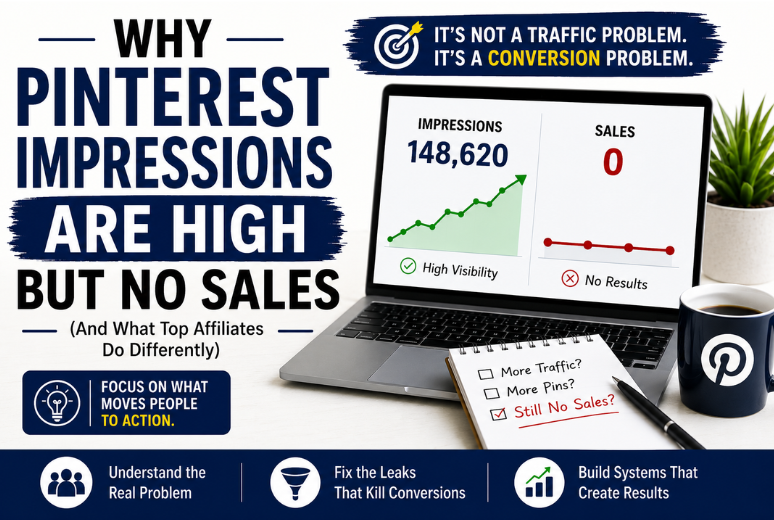
You open analytics.
The numbers look encouraging.
Impressions are climbing.
Pins are circulating.
Traffic appears to be moving.
For a moment—
it feels like progress.
Then you check the numbers that matter.
Clicks feel inconsistent.
Sales barely move.
And suddenly the question appears:
Why is all this traffic not turning into results?
Most affiliate marketers answer that question the same way.
They assume they need:
More impressions.
More pins.
More content.
More reach.
So they push harder.
But often—
nothing changes.
That’s because more visibility does not automatically create more revenue.
And that realization changes everything.
Quick Answer: Why Pinterest Impressions Are High but No Sales
If Pinterest impressions are increasing but affiliate results remain flat—
the problem usually isn’t traffic.
It’s what happens after the traffic arrives.
Common causes:
Pins attract curiosity instead of intent.
Content attracts discovery instead of decisions.
People leave without continuing the relationship.
Expectations break after the click.
There is no path beyond exposure.
Top affiliates think differently.
They optimize for movement.
Movement toward trust.
Movement toward understanding.
Movement toward action.
That shift compounds.
Why Pinterest Impressions Are High but No Sales Even With More Reach
Impressions feel productive.
They create visible movement.
You refresh analytics.
Numbers rise.
And naturally—
you expect sales to follow.
But Pinterest does not work like a checkout line.
People arrive in exploration mode.
They compare.
Research.
Save.
Return later.
That behavior changes conversion.
Because discovery and decisions are not the same thing.
Someone looking for:
Ideas
Behaves differently from someone looking for:
Solutions
That distinction explains why large reach often creates surprisingly small results.
The Metric That Quietly Distracts Smart People
Impressions create excitement.
Revenue usually arrives later.
That gap causes people to optimize the wrong thing.
The assumption becomes:
More traffic
↓
More clicks
↓
More income
But real conversion often looks closer to:
Attention
↓
Trust
↓
Action
Miss one layer—
and results feel inconsistent.
That’s why smaller creators sometimes outperform larger accounts.
Not because they attract more people.
Because they create more movement.
Attention vs Intent
This distinction matters more than most affiliate marketers realize.
Attention means:
People noticed.
Intent means:
People care.
Those are different states.
Examples:
Discovery Attention:
affiliate marketing ideas
online business inspiration
make money online
Intent Signals:
affiliate marketing strategy
Pinterest traffic system
email audience growth
People searching with intent behave differently.
That changes everything after the click.
Why Viral Pins Often Convert Worse
This surprises people.
A pin explodes.
Huge reach.
Huge saves.
Massive impressions.
Revenue barely moves.
Meanwhile—
another pin quietly continues performing.
Why?
Because inspiration and action are different.
Pinterest creates inspiration.
Business growth requires decisions.
The goal isn’t:
Maximum visibility.
The goal becomes:
Relevant movement.
That distinction creates better content.
If you’re realizing that more impressions alone don’t guarantee better results—
explore a beginner-friendly system designed around creating more opportunities after the click instead of depending entirely on visibility.
No complicated setup.
What Top Affiliates Quietly Build Instead
Most people assume successful affiliates win because they publish more.
More content.
More pins.
More reach.
But if you look closer—
something else is happening.
They are usually building systems that continue creating value after discovery.
That changes the economics.
Because a visitor stops becoming a one-time event.
And starts becoming future opportunity.
Audience Continuity Changes Conversion
Pinterest behavior creates a unique challenge.
People rarely arrive ready to act immediately.
They collect.
Save.
Explore.
Return later.
That behavior is normal.
But most affiliates treat every click like the final step.
That creates friction.
The stronger model looks different:
Pinterest
↓
Content
↓
Audience
↓
Trust
↓
Recommendation
That sequence compounds.
Because relationships extend timelines.
And longer timelines often improve decisions.
The Conversion Gap Nobody Talks About
Most people think conversion problems happen because:
Wrong niche.
Weak design.
Poor timing.
Sometimes.
But often—
conversion stalls because attention and expectations become disconnected.
Example:
A pin promises strategy.
The next page pushes decisions.
That mismatch creates friction.
The stronger approach:
Pin promise
↓
Content continuation
↓
Useful next step
People move more naturally when momentum stays intact.
Build Content Ecosystems Instead Of Isolated Posts
One article should not work alone.
One pin should not carry your business.
Build clusters.
Example:
Main Topic:
Pinterest Affiliate Growth
Supporting Content:
Why Pinterest impressions are high but no sales
Why every Pinterest affiliate needs an email list
How to build an email list for affiliate marketing beginners
Why Most Affiliate Marketers Stay Stuck
Each piece strengthens the others.
People continue.
Search engines understand relationships.
Readers do too.
That creates leverage.
Continue Reading
→ Read:
How to Build an Email List for Affiliate Marketing Beginners
→ Read:
Why Every Pinterest Affiliate Needs an Email List
Trust Systems Beat Traffic Systems
This is one of the least obvious lessons in affiliate marketing.
Traffic creates opportunity.
Trust creates outcomes.
Trust does not usually arrive instantly.
It grows.
Repeated value.
Repeated usefulness.
Repeated consistency.
That accumulation creates confidence.
And confidence changes conversion.
Why Top Affiliates Think Differently
Most affiliates ask:
How do I get more clicks?
Top affiliates often ask:
How do I create more value from the clicks I already have?
That shift changes everything.
Because optimization becomes less about volume—
and more about momentum.
Build Simpler Systems First
Most beginners assume low conversions mean they need:
More software.
More automation.
More complexity.
Usually—
they need better alignment.
Focus on:
Clear messaging.
Useful content.
Consistent publishing.
Better relationships.
Simple systems scale better than complicated ones.
If you’re realizing that visibility and conversion are two different problems—
there’s a beginner-friendly system worth exploring.
Designed around creating opportunities beyond the initial click.
No complicated setup.
Why Impressions Feel Good But Mislead People
Impressions create visible progress.
You publish.
Numbers move.
Analytics become exciting.
That feedback loop feels productive.
But impressions can become misleading when they replace deeper questions.
Questions like:
Did people continue?
Did people engage?
Did they return?
Did they move forward?
Those questions reveal much more.
Because business growth usually happens below the surface before it appears in results.
The Real Metric Shift
Most beginners track:
Impressions
Followers
Reach
Clicks
Those numbers matter.
But they are not the full picture.
Start asking:
Did the content create trust?
Did people continue learning?
Did relationships deepen?
Did momentum increase?
Those measurements create better decisions.
Because the goal isn’t:
Maximum exposure.
It’s sustainable movement.
Common Pinterest Conversion Mistakes
Treating Discovery Like Conversion
Discovery creates opportunity.
It does not guarantee action.
Different stages require different expectations.
Sending People Into Dead Ends
Every click should continue the conversation.
People rarely move forward from confusion.
Publishing Without A Content Path
Each article should support another.
Each pin should connect to a larger idea.
Clusters outperform isolated content.
Assuming More Reach Fixes Weak Systems
More visibility magnifies strengths.
It also magnifies weaknesses.
Alignment matters.
What Happens When You Stop Chasing Impressions
Something interesting happens.
You stop refreshing analytics constantly.
You stop measuring success by spikes.
You stop assuming every result should happen immediately.
Because your content starts stacking.
Pins support articles.
Articles support relationships.
Relationships support future opportunities.
That’s when growth begins feeling more predictable.
Frequently Asked Questions
Why Pinterest Impressions Are High but No Sales For Most Beginners
Not automatically.
Traffic creates opportunity.
Conversion creates outcomes.
Those are different systems.
Should I send Pinterest traffic directly to affiliate offers?
Usually not.
People often respond better when context and value happen first.
Why do clicks feel real but commissions feel inconsistent?
Because curiosity and decisions are different behaviors.
Strong content helps shorten that distance.
Does Pinterest traffic usually take longer?
Often yes.
People tend to explore before they act.
That’s why consistency matters.
Continue Reading
→ Read:
How to Build an Email List for Affiliate Marketing Beginners
→ Read:
Why Every Pinterest Affiliate Needs an Email List
Ready To Turn Pinterest Traffic Into Something That Lasts?
Getting impressions feels exciting.
But visibility alone rarely creates stability.
The strongest affiliate businesses usually build ways to continue helping people after the click.
If you want to explore a beginner-friendly system designed around creating more opportunities instead of constantly restarting—
No complicated setup.
Final Thought
People who understand why Pinterest impressions are high but no sales usually stop chasing more reach and start improving alignment.
You probably do not have a traffic problem.
Most people don’t.
They have a system problem.
They create attention—
but never build momentum.
Traffic matters.
But relationships compound.
And building something people can return to tomorrow…
is often where long-term growth begins.