How to Build Trust Before Affiliate Marketing: The 7-Step Framework That Turns Skeptical Visitors Into Loyal Buyers
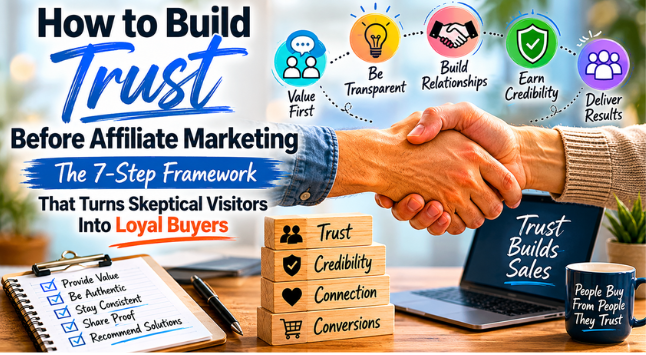
How to build trust before affiliate marketing is one of the most important skills a new affiliate can develop, yet it’s often overlooked in favor of traffic strategies and promotion tactics.
Many marketers spend months trying to generate more clicks without realizing that trust is what ultimately turns visitors into buyers. Before someone purchases through your affiliate link, they first need confidence in the person making the recommendation.
Most Affiliate Marketers Think They Have a Traffic Problem
At first, it seems obvious.
If more people visited your website, more people would click your links.
If more people clicked your links, more sales would happen.
And if more sales happened, affiliate marketing would finally start feeling worth the effort.
That’s the logic most beginners follow.
So they spend countless hours learning traffic generation.
They study SEO.
Experiment with social media.
Create Pinterest pins.
Write blog posts.
Watch YouTube tutorials.
Join Facebook groups.
Research keyword strategies.
And slowly, traffic starts showing up.
The numbers begin moving.
Visitors arrive.
Page views increase.
Clicks start appearing.
Then something unexpected happens.
Nothing else changes.
No meaningful increase in commissions.
No sudden breakthrough.
No flood of affiliate sales.
Just traffic.
And a growing sense of confusion.
Because if traffic is arriving, why aren’t people buying?
The answer often surprises people.
Traffic isn’t always the problem.
Trust is.
The Silent Questions Every Visitor Is Asking
Every person who lands on your website brings something with them.
Not luggage.
Not a wallet.
Something far more important.
Skepticism.
They’ve seen exaggerated claims before.
They’ve bought products that failed to deliver.
They’ve followed marketers who seemed helpful at first but eventually turned every conversation into a sales pitch.
So when they discover your content, they immediately begin asking questions.
Not out loud.
Inside their head.
Questions like:
- Can I trust this person?
- Do they really understand what I’m struggling with?
- Have they actually used what they’re recommending?
- Are they trying to help me solve a problem?
- Or are they simply trying to earn a commission?
Most affiliate marketers never think about these questions.
But buyers do.
And the answers influence every decision that follows.
Long before someone clicks your affiliate link, they’ve already begun evaluating you.
That’s why trust becomes such an important part of affiliate marketing success.
People rarely buy because they discover a product.
More often, they buy because they trust the person introducing them to it.
Why Trust Is Becoming More Valuable Every Year
The internet has become noisy.
Every platform is crowded.
Every feed is full.
Every day brings another expert.
Another recommendation.
Another “secret strategy.”
Another promise.
Consumers aren’t overwhelmed because information is scarce.
They’re overwhelmed because information is everywhere.
And when people become overwhelmed, they become cautious.
That’s not negativity.
It’s self-protection.
Modern consumers have learned to filter what they see.
They question claims.
Investigate recommendations.
Research alternatives.
Compare options.
Trust is no longer given freely.
It’s earned.
The marketers who understand this stop trying to become louder.
Instead, they focus on becoming more believable.
And that simple shift changes everything.
The Quick Answer: How to Build Trust Before Affiliate Marketing
If you’re looking for the short version, trust is built through seven simple principles:
- Share stories that feel real.
- Demonstrate genuine experience.
- Give value before asking for anything.
- Show up consistently.
- Practice transparency.
- Use proof responsibly.
- Recommend solutions instead of products.
None of these ideas are complicated.
The challenge is that they require patience.
And patience isn’t always popular in an industry obsessed with shortcuts.
Yet the affiliate marketers who build long-term success almost always follow these same principles.
Not because they’re trendy.
Because they work.
Why Most Affiliate Marketers Start Promoting Too Soon
Excitement is a wonderful thing.
It’s also responsible for some of the biggest mistakes affiliate marketers make.
A new marketer discovers a product.
They’re impressed.
They see potential.
They genuinely believe it could help people.
So naturally, they want to start promoting it immediately.
The problem?
Their audience isn’t emotionally ready yet.
Trust hasn’t been established.
The relationship hasn’t been built.
The conversation hasn’t developed.
From the marketer’s perspective, the recommendation feels helpful.
From the visitor’s perspective, it often feels premature.
And that difference matters.
Because recommendations made too early tend to feel like interruptions.
Recommendations made after trust is established feel like guidance.
The product hasn’t changed.
The timing has.
And timing plays a major role in conversions.
The Trust Bank Account Most Affiliates Never Notice
One of the simplest ways to understand trust is to imagine a bank account.
Every helpful article creates a deposit.
Every useful email creates a deposit.
Every honest recommendation creates a deposit.
Every problem solved creates a deposit.
Over time, those deposits accumulate.
Trust grows.
Confidence increases.
Relationships deepen.
Now imagine the opposite.
A marketer constantly pushing offers.
Constantly promoting products.
Constantly asking for clicks.
Without first creating value.
Those actions create withdrawals.
Eventually the account becomes empty.
And when trust runs low, conversions usually follow.
The most successful affiliate marketers understand that recommendations work best when they’re backed by a healthy trust balance.
They invest first.
They ask later.
And that’s one of the reasons their content performs differently.
Why Skeptical Audiences Create Opportunity
At first glance, modern skepticism seems like a problem.
It’s not.
In many ways, it’s an advantage.
Because while countless marketers are still chasing attention, relatively few are focused on building credibility.
Most people are trying to be seen.
Far fewer are trying to be trusted.
That’s where the opportunity lives.
When you consistently provide value, tell the truth, share real experiences, and help people solve problems, you immediately stand out.
Not because you’re doing something revolutionary.
Because you’re doing something increasingly rare.
You’re earning trust before asking for action.
And that creates a powerful competitive advantage.
What Trust Actually Means in Affiliate Marketing
Trust is often misunderstood.
Many people assume trust simply means being liked.
But being liked and being trusted are not the same thing.
Someone may enjoy your content.
Follow your social media posts.
Read your emails.
Watch your videos.
And still hesitate when it’s time to make a buying decision.
Real trust runs deeper.
In affiliate marketing, trust is built on two foundations.
And both matter.
Competence Trust: Can This Person Actually Help Me?
The first question people ask is practical.
Can this person solve the problem I’m trying to solve?
Visitors want evidence that you understand what you’re talking about.
They want clarity.
Guidance.
Experience.
They want to feel confident that following your advice moves them closer to their goal.
This type of trust isn’t built through big claims.
It’s built through useful content.
Helpful explanations.
Practical insights.
Real-world understanding.
Every time you make something complicated easier to understand, competence trust grows.
Character Trust: Do This Person’s Motives Align With Mine?
Competence earns attention.
Character earns loyalty.
Readers eventually begin asking a different question.
What kind of person is this?
Are they honest?
Transparent?
Authentic?
Do they genuinely care about helping people?
Or is every recommendation motivated entirely by commissions?
This is where many long-term affiliate businesses are won or lost.
Because people don’t just buy solutions.
They buy confidence.
And confidence often comes from believing the person making the recommendation has their best interests in mind.
That’s why character trust is so powerful.
Once people trust your motives, your recommendations naturally carry more weight.
And that’s when affiliate marketing starts feeling less like selling and more like helping.
Step 1: Share Stories People Can See Themselves In
Before people trust your recommendations, they need a reason to trust you.
One of the fastest ways to create that connection is through storytelling.
Not polished stories.
Not manufactured stories.
Real stories.
Stories with uncertainty.
Stories with mistakes.
Stories with lessons learned the hard way.
Because people don’t connect with perfection.
They connect with honesty.
Maybe you spent months trying to earn your first commission.
Maybe you bought tools that didn’t work.
Maybe you followed bad advice.
Maybe you struggled longer than you expected.
Those experiences matter.
In fact, they’re often more valuable than your successes.
Because readers recognize themselves inside them.
And when readers see pieces of their own journey inside yours, something important happens.
Trust begins to form.
Not because you’ve proven you’re perfect.
But because you’ve proven you’re real.
Why Stories Build Trust Faster Than Facts
Facts educate.
Stories connect.
A statistic might teach someone something new.
A story helps them feel understood.
And people remember what makes them feel understood.
Human beings are naturally wired for narrative.
That’s why stories have survived every generation, every technology shift, and every communication platform.
When you tell a meaningful story, readers don’t simply consume information.
They experience it.
They imagine themselves inside it.
They emotionally participate.
And emotional participation creates connection.
Connection creates trust.
And trust creates influence.
That’s why some marketers can share a simple story and create more impact than someone sharing pages of statistics.
Facts are useful.
Stories are memorable.
The most effective affiliate marketers understand how to use both.
Step 3: Give Before You Ask
There is a reason some affiliate marketers seem to generate sales almost effortlessly while others feel like they’re constantly pushing uphill.
It has very little to do with persuasion.
And almost everything to do with timing.
Many struggling affiliates ask for something before they’ve earned the right to ask.
They ask for clicks before they’ve built confidence.
They ask for sales before they’ve delivered value.
They ask for commitment before they’ve established trust.
From the marketer’s perspective, it feels reasonable.
From the visitor’s perspective, it often feels rushed.
And that difference changes everything.
Imagine walking into a store and having a salesperson immediately start pushing products before they’ve asked a single question.
Most people instinctively pull away.
Not because they hate buying.
Because they dislike being pressured.
Online audiences react the same way.
The marketers who build trust understand a simple principle:
The fastest way to receive value is to create value first.
Why Helpful Content Creates Momentum
Think about the last time someone genuinely helped you.
Maybe they solved a problem that had been frustrating you for days.
Maybe they explained something clearly when everyone else made it complicated.
Maybe they saved you time, money, or stress.
How did you feel afterward?
Grateful.
Relieved.
More open to listening to them in the future.
That’s not an accident.
It’s human psychology.
When someone consistently helps us, we naturally become more receptive to their guidance.
In affiliate marketing, this principle becomes incredibly powerful.
Every helpful article.
Every useful email.
Every practical tutorial.
Every problem solved.
These interactions create positive deposits into the trust account.
Over time, readers stop viewing your content as marketing.
They begin viewing it as a resource.
And resources earn attention in a way advertisements rarely do.
Why Small Wins Matter More Than Most People Realize
One of the biggest misconceptions in affiliate marketing is the belief that you need to transform someone’s life before they’ll trust you.
You don’t.
In many cases, a small win is enough.
Helping someone avoid a mistake.
Helping them understand a confusing concept.
Helping them solve a simple problem.
Those moments matter.
Because progress creates momentum.
And momentum creates trust.
A beginner finally understands how affiliate links work.
A marketer learns how to build their first landing page.
A blogger discovers a better keyword strategy.
A subscriber gains their first few email leads.
None of these victories will make headlines.
But they build confidence.
And confidence is often the foundation of trust.
When someone experiences progress because of your guidance, they begin associating your content with positive outcomes.
That’s powerful.
The Value-First Framework Trusted Affiliates Follow
The most respected affiliate marketers rarely begin with a recommendation.
Instead, they guide people through a process.
A natural progression that mirrors how trust develops.
Stage One: Awareness
Help people understand the problem.
What is happening?
Why is it happening?
What common mistakes are making the situation worse?
At this stage, clarity matters more than solutions.
Stage Two: Understanding
Now help them make sense of the problem.
Provide context.
Offer insight.
Remove confusion.
People trust those who simplify complexity.
Stage Three: Action
Show readers how to take meaningful steps forward.
Provide frameworks.
Checklists.
Examples.
Templates.
Help them move from learning to doing.
Stage Four: Recommendation
Only after value has been delivered does the recommendation enter the conversation.
And when it does, it feels natural.
Not because you’re selling harder.
Because you’ve earned the opportunity to be heard.
That’s the difference.
Step 4: Become Familiar Through Consistency
Trust rarely arrives all at once.
It grows through repetition.
Interaction by interaction.
Experience by experience.
Most people won’t trust you after reading a single article.
They won’t become loyal subscribers after one email.
And they probably won’t buy because of one social media post.
Trust accumulates.
Quietly.
Gradually.
Almost invisibly.
Which is why consistency matters so much.
Familiarity Is One of the Strongest Trust Signals
There’s a fascinating psychological principle called the familiarity effect.
The more often people encounter something in a positive context, the more comfortable they become with it.
You see it everywhere.
Friendships.
Communities.
Brands.
Relationships.
Affiliate marketing works the same way.
Every time someone reads one of your articles.
Every time they open one of your emails.
Every time they learn something useful from your content.
Another layer of uncertainty disappears.
You become more familiar.
More recognizable.
More trusted.
That’s why consistency often outperforms occasional brilliance.
Trust prefers reliability over intensity.
Why Consistency Beats Perfection
Many content creators delay progress because they’re waiting for perfect conditions.
The perfect article.
The perfect strategy.
The perfect video.
The perfect moment.
Weeks pass.
Months pass.
And nothing gets published.
Meanwhile, someone else continues showing up consistently.
They’re not perfect.
But they’re present.
And presence builds trust.
Your audience doesn’t need flawless content.
They need evidence that you’ll continue showing up.
Reliability communicates stability.
And stability creates confidence.
People naturally trust those who remain committed long after the initial excitement fades.
Building a Trust Ecosystem
Most affiliate sales don’t happen during a first interaction.
In reality, buying journeys are often much longer than people realize.
Someone might find your blog through Google.
Subscribe to your email list a few days later.
Follow you on Facebook the following week.
Watch one of your videos a month later.
Read another article.
Open several emails.
Then finally make a purchase.
From the outside, it appears simple.
Behind the scenes, trust has been building the entire time.
Every touchpoint matters.
Every interaction contributes.
Every piece of content either strengthens credibility or weakens it.
The marketers who understand this stop focusing on isolated sales.
Instead, they focus on building systems that create trust repeatedly.
That’s how long-term affiliate businesses are built.
Step 5: Practice Radical Transparency
There was a time when marketers believed transparency was risky.
Today, transparency has become one of the strongest competitive advantages available.
Consumers are remarkably good at sensing when something feels hidden.
They notice vague claims.
They recognize exaggeration.
They spot inconsistencies.
And once uncertainty appears, trust begins to erode.
The solution isn’t becoming more persuasive.
It’s becoming more honest.
Tell People How You Benefit
Some affiliate marketers still hesitate to disclose affiliate relationships clearly.
They worry that commissions will reduce trust.
In reality, transparency usually increases it.
Most readers understand that content creators need to earn money.
What they dislike is feeling misled.
A simple disclosure communicates confidence.
It says:
“I believe this recommendation can help you. If you decide it’s a good fit, I may earn a commission at no additional cost to you.”
Simple.
Direct.
Respectful.
The recommendation feels cleaner because the motivation is visible.
And visible motives are easier to trust than hidden ones.
Why Perfect Products Don’t Exist
One of the fastest ways to lose credibility is pretending every recommendation is flawless.
Readers know better.
Every tool has strengths.
Every tool has weaknesses.
Every strategy involves trade-offs.
Every platform has limitations.
When you openly discuss both sides, something interesting happens.
Your recommendations become more believable.
Balanced opinions feel authentic because real-world experience is rarely one-sided.
The goal isn’t convincing everyone.
The goal is helping the right people make informed decisions.
That’s a very different mindset.
And readers notice the difference.
Vulnerability Creates Connection
Many people assume authority comes from appearing successful.
Sometimes it does.
But trust often comes from honesty.
Sharing mistakes.
Discussing failures.
Admitting setbacks.
Talking openly about lessons learned.
These experiences humanize you.
They transform polished advice into lived experience.
Readers stop seeing someone on a pedestal.
They start seeing someone walking the same path they’re trying to navigate.
And that creates connection.
Connection builds trust.
And trust makes every future recommendation stronger.
Because people rarely trust perfection.
They trust authenticity.
Step 6: Let Proof Do the Talking
Trust requires evidence.
Not hype.
Not exaggerated claims.
Not carefully curated success stories that seem too perfect to be true.
Real evidence.
The kind that quietly answers questions before they’re ever asked.
By this point in the relationship, your audience is no longer wondering whether you’re helpful.
They’re asking something deeper:
“Can I actually believe this will work?”
That’s where proof becomes essential.
But many affiliate marketers make a critical mistake.
They confuse proof with performance.
And those two things are very different.
The Difference Between Credibility and Showmanship
There is a reason some income screenshots build trust while others create skepticism.
The difference isn’t the amount of money shown.
It’s the intent behind it.
Readers are surprisingly good at sensing motives.
They can tell when someone is sharing results to educate.
And they can tell when someone is sharing results simply to impress.
One creates credibility.
The other creates distance.
People don’t necessarily trust the person with the biggest result.
They trust the person who helps them understand how a result was achieved.
Context matters.
Without context, proof feels like advertising.
With context, it becomes education.
And education is far easier to trust.
Show the Process, Not Just the Outcome
Outcomes attract attention.
Processes build belief.
Imagine reading these two statements:
“I made $5,000 last month.”
Interesting.
But incomplete.
Now compare it to:
“I spent six months publishing content, building an email list, testing offers, and refining my strategy before generating $5,000 in commissions.”
Suddenly the result feels different.
It feels attainable.
Understandable.
Human.
Readers can visualize the journey.
And when people can visualize progress, they begin believing progress is possible for them too.
That’s why process-driven content often creates more trust than outcome-driven content.
The outcome gets attention.
The process earns credibility.
Why Modest Results Often Create More Trust
This surprises many affiliate marketers.
Smaller victories are often more persuasive than dramatic success stories.
Why?
Because people can relate to them.
A new affiliate sharing their first commission.
A blogger explaining how they gained their first subscribers.
A marketer discussing lessons learned from an early campaign.
These experiences feel real.
And reality is persuasive.
Huge income claims often create emotional distance.
Modest, believable wins create connection.
Connection creates trust.
And trust drives action.
Community Validation Matters More Than Ever
There is another form of proof that’s often overlooked.
It doesn’t come from you.
It comes from the people you’ve helped.
A thoughtful comment.
A success story from a subscriber.
An email thanking you for solving a problem.
A reader implementing your advice successfully.
These moments carry tremendous weight.
Because they’re independent.
The validation isn’t coming from the marketer.
It’s coming from someone else.
And people naturally trust other people.
That’s why authentic feedback remains one of the strongest trust signals available.
Eventually, your audience begins hearing positive things about you from sources beyond yourself.
That’s when credibility starts taking on a life of its own.
Step 7: Recommend Solutions, Not Products
This final step separates trusted affiliates from transactional affiliates.
Most affiliate marketers focus on products.
Trusted affiliate marketers focus on problems.
That difference sounds small.
It’s not.
It’s enormous.
Because people rarely wake up wanting another tool.
They want a better outcome.
A better future.
A better result.
The product is simply a vehicle that helps them get there.
People Buy Outcomes, Not Features
Think about what your audience actually wants.
They don’t want email software.
They want subscribers.
They don’t want a funnel builder.
They want leads.
They don’t want keyword research tools.
They want traffic.
Growth.
Visibility.
Results.
When you begin focusing on the outcome instead of the product, everything changes.
Your recommendations become more persuasive because they align with the goals your audience already has.
You’re no longer selling features.
You’re helping people move closer to a desired result.
And that’s a much easier conversation to have.
Become the Guide, Not the Salesperson
People resist being sold.
But they rarely resist being helped.
The difference comes down to positioning.
A salesperson begins with the offer.
A guide begins with the problem.
When discussing affiliate recommendations, start by helping readers understand:
- Why the problem exists.
- What is causing it.
- What options are available.
- What trade-offs should be considered.
- Which solution best fits their situation.
This approach transforms the recommendation.
Instead of feeling like a pitch, it feels like guidance.
And guidance creates trust.
The Solution-First Recommendation Framework
Before recommending any affiliate product, walk readers through this sequence.
Define the Problem
What challenge are they facing?
What obstacle is preventing progress?
Clarify the Desired Outcome
What result are they hoping to achieve?
What does success look like?
Explore Available Options
Discuss multiple solutions honestly.
Demonstrate objectivity.
Show readers that you’re focused on helping them make the right decision.
Introduce Your Recommendation
Present the product naturally as a solution.
Explain why it fits.
Not why it pays.
Explain Who It’s For—and Who It Isn’t For
This simple step dramatically increases trust.
Not every product is right for every person.
When you openly acknowledge that reality, readers recognize that you’re prioritizing their success over your commission.
And that’s exactly what trusted advisors do.
The Fastest Ways to Destroy Trust
Building trust takes time.
Losing it can happen surprisingly fast.
Many affiliate marketers unknowingly damage their credibility through habits that seem harmless in the moment.
Recommending Everything
If every product receives glowing praise, readers notice.
Eventually every recommendation starts feeling transactional.
Selectivity matters.
People trust recommendations more when they know you say “no” more often than you say “yes.”
Prioritizing Commissions Over Outcomes
Audiences eventually figure out what motivates you.
If every piece of content feels designed to generate a commission, trust begins to weaken.
The most successful affiliate marketers understand a simple principle:
Trust creates commissions.
Commissions do not create trust.
Focus on outcomes first.
The revenue usually follows.
Exaggerating Results
Short-term attention can be expensive.
An exaggerated claim might generate clicks today.
But if expectations and reality fail to match, trust suffers.
And trust is much harder to rebuild than traffic.
Honesty may grow more slowly.
But it creates stronger foundations.
Hiding Motivations
Most people don’t mind affiliate commissions.
They understand that creators deserve to be compensated for their work.
What people dislike is uncertainty.
Transparency removes uncertainty.
And uncertainty is one of trust’s biggest enemies.
Inconsistency
Trust relies on predictability.
Not perfection.
Predictability.
When values constantly shift, recommendations change weekly, or messaging feels disconnected, people become unsure.
Consistency signals reliability.
Reliability creates confidence.
Confidence creates trust.
Why Trust Changes Everything
Many marketers think trust is difficult to measure.
In reality, its effects appear everywhere.
When trust grows:
- People spend more time with your content.
- They return more often.
- They open more emails.
- They engage more deeply.
- They click more recommendations.
- They share your content.
- They refer friends.
- They buy with greater confidence.
The benefits compound.
And that’s what makes trust so powerful.
Traffic can disappear.
Algorithms can change.
Platforms can come and go.
Trust travels with you.
From platform to platform.
From audience to audience.
From one opportunity to the next.
It becomes an asset that continues appreciating over time.
And unlike traffic, it’s something no algorithm can take away.
Frequently Asked Questions
How long does it take to build trust online?
Usually longer than people hope and faster than people expect.
Trust isn’t built through a single article or email.
It’s built through repeated positive experiences.
Every helpful interaction contributes to the process.
Eventually readers stop consciously evaluating whether they trust you and simply begin assuming they do.
Can beginners build trust without big results?
Absolutely.
In many cases, beginners have an advantage.
People relate to authentic journeys.
You don’t need extraordinary success stories.
You need honesty.
Share what you’re learning.
Document your progress.
Discuss mistakes openly.
Authenticity often builds trust faster than perfection.
Should I wait before promoting affiliate products?
Not necessarily.
The better question is whether you’ve created enough value first.
Promotion works best when it feels like a continuation of the conversation rather than the beginning of one.
The stronger the trust foundation, the easier recommendations become.
Is trust really more important than traffic?
Traffic matters.
Trust matters more.
A smaller audience that trusts you will often outperform a much larger audience that doesn’t.
Conversions improve.
Relationships deepen.
And those advantages compound over time.
Can trust compensate for limited expertise?
Only to a point.
Trust is strongest when competence and character work together.
People need confidence that you understand the problem and genuinely care about helping them solve it.
Both are necessary.
Together, they create a foundation that is difficult to replicate.
Want to See a Trust-First Affiliate Marketing System in Action?
One of the biggest lessons I’ve learned is that people rarely buy from strangers.
That’s why I focus on building relationships, growing an email list, and creating trust before promoting affiliate offers.
If you’d like to see the system I’m using to build an audience while creating affiliate commissions at the same time,
It’s a simple model built around audience ownership, follow-up marketing, and long-term relationship building rather than chasing one-time clicks.
Final Thoughts
If there’s one lesson every affiliate marketer eventually learns, it’s this:
People buy from people they trust.
Not because trust eliminates risk.
Because trust reduces uncertainty.
And uncertainty is what prevents most buying decisions.
The marketers who thrive long term aren’t necessarily the loudest.
They aren’t always the most experienced.
And they aren’t always the ones generating the most traffic.
They’re the ones who consistently earn confidence.
One article at a time.
One email at a time.
One conversation at a time.
Trust is built slowly.
But once it’s established, it becomes one of the most valuable assets your business will ever own.
And unlike traffic, rankings, or algorithms…
Trust is something you get to keep.