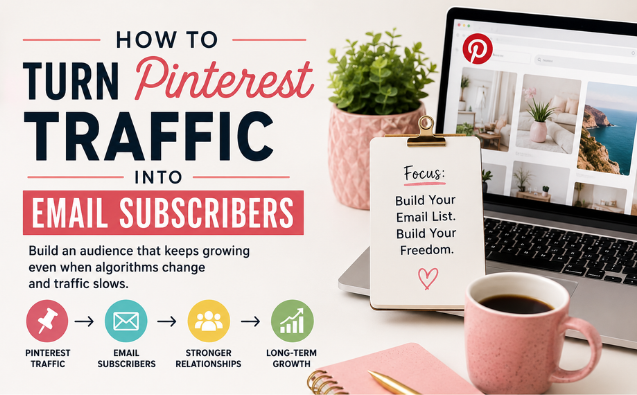
How to Turn Pinterest Traffic Into Email Subscribers Before an Algorithm Change Erases Your Growth
There is a moment most creators eventually experience.
Traffic slows.
Pins stop moving the way they used to.
Analytics become unpredictable.
Nothing dramatic.
Just enough change to create a quiet question:
If the platform changed tomorrow…
would my growth survive?
That question changes how you think.
Because traffic and audience are not the same thing.
Traffic arrives.
Audience stays.
And understanding that difference often becomes the point where creators stop chasing more visibility and start building something more durable.
Pinterest creates one of the most interesting opportunities online.
People rarely arrive to socialize.
They arrive searching.
Comparing.
Collecting ideas.
Planning next steps.
That behavior creates momentum.
But momentum without ownership eventually creates dependency.
And that’s why learning how to turn Pinterest traffic into email subscribers matters.
Not because email is magical.
Because continuity changes growth.
Quick Answer: How To Turn Pinterest Traffic Into Email Subscribers
If you want the simple version:
Create Pinterest content around useful intent.
Send visitors into focused content.
Continue helping after the click.
Reduce friction.
Create momentum.
Deliver useful experiences.
Continue the relationship.
Introduce recommendations naturally.
Traffic creates discovery.
Subscribers create continuity.
Continuity compounds.
Why Pinterest Growth Feels Stable Until It Doesn’t
Pinterest behaves differently than many platforms.
That’s one reason people trust it.
Pins continue circulating.
Traffic can remain steady.
Content often lasts longer.
But stability can create false confidence.
Because platforms evolve.
Search behavior changes.
Recommendations shift.
Competition increases.
And when all growth depends on discovery—
growth becomes fragile.
That’s when ownership starts mattering.
Creators with ways to continue helping people usually adapt more easily.
Reach Is Temporary. Relationships Compound.
Most dashboards highlight:
Impressions
Clicks
Traffic
Saves
Those metrics matter.
But they only describe arrival.
Different questions describe growth:
Did people continue?
Did people engage?
Did they return?
Did they move forward?
Those questions reveal something deeper.
Because content creates moments.
Relationships extend those moments.
The Audience Model That Changes Everything
Many affiliate marketers unintentionally build this:
Pinterest
↓
Offer
↓
Hope
It feels efficient.
But efficiency is not always leverage.
A stronger model:
Pinterest
↓
Content
↓
Audience
↓
Relationship
↓
Recommendation
That additional layer changes outcomes.
Because visitors stop behaving like isolated events.
And begin creating future opportunities.
Understanding Why People Continue
People rarely continue because they are impressed.
They continue because they believe something useful is happening.
Your job is not convincing.
Your job is reducing uncertainty.
People quietly ask:
Is this useful?
Does this help?
What happens next?
Will this move me forward?
The easier those answers become—
the easier continuation becomes.
Stage 1 — Discovery: Where Pinterest Does Its Best Work
Pinterest creates discovery differently.
People arrive with intention.
They want ideas.
Clarity.
Progress.
That means content does not need to force decisions.
It needs to create movement.
Good Pinterest content creates:
Recognition
Curiosity
Momentum
Useful next steps
Not pressure.
Movement.
If building something that survives traffic changes sounds more appealing than constantly restarting—
explore a beginner-friendly system designed around creating more opportunities after the click.
No complicated setup.
Content That Naturally Encourages Continuation
One of the biggest misunderstandings in affiliate marketing is believing people continue because content impressed them.
Usually—
people continue because content reduced uncertainty.
That changes how you think about growth.
Your goal becomes:
Not:
Get the click.
But:
Create a reason to continue.
People arrive asking:
What do I do next?
Useful content answers that question.
Why Most Landing Experiences Quietly Lose Momentum
Most people assume visitors leave because they are not interested.
Sometimes.
But often—
people leave because they became uncertain.
Common causes:
Too many choices.
Too much explanation.
Too many directions.
Too much effort.
Visitors do not arrive hoping to think harder.
They want clarity.
The strongest experiences usually feel simple.
People understand.
People continue.
A Simpler Structure That Creates Movement
Think about the next step like this:
Clear headline
↓
Useful expectation
↓
Simple explanation
↓
One action
↓
Confidence
↓
Continuation
That is enough.
You do not need endless pages.
You do not need complicated systems.
You need fewer decisions.
Build Momentum Instead Of Complexity
Most creators believe growth problems require more infrastructure.
More tools.
More pages.
More automation.
Usually—
they need more alignment.
Ask:
Does this create clarity?
Does this make progress easier?
Does this help people continue?
Simple experiences often outperform complicated ones.
Because momentum matters more than mechanics.
Relationships Start After Discovery
Discovery creates opportunity.
Relationships create continuity.
That shift matters.
Because traffic behaves differently than people.
Traffic appears.
People stay.
Once someone continues—
the goal changes.
Help.
Clarify.
Reduce friction.
Create progress.
Repeated useful experiences create trust.
Trust changes outcomes.
Trust Is Built Through Small Wins
People rarely trust because of information.
They trust because of progress.
Think smaller.
One useful insight.
One simple action.
One moment of clarity.
Small wins create confidence.
Confidence creates continuation.
That continuation compounds.
Continue Reading
→ Read:
How to Build an Email List for Affiliate Marketing Beginners
→ Read:
Why Every Pinterest Affiliate Needs an Email List
→ Read:
Why Pinterest Impressions Are High but No Sales
Stop Thinking About Subscribers As Numbers
This is where growth starts changing.
Subscribers are easy to count.
Relationships are harder to measure.
But relationships create leverage.
Because every future article.
Every future email.
Every future recommendation—
starts from trust instead of starting over.
That is where compounding begins.
Build Simpler Systems That Compound
Instead of:
Traffic
↓
Offer
↓
Repeat
Build:
Discovery
↓
Content
↓
Relationship
↓
Recommendation
↓
Future Opportunity
Simple systems scale.
Because consistency compounds.
If you’re realizing that traffic alone rarely creates stability—
there’s a beginner-friendly system worth exploring.
Designed around creating opportunities after the click instead of depending entirely on discovery.
No complicated setup.
Future-Proof Growth Before You Need It
There is a subtle change that happens when someone stops thinking like a content creator—
and starts thinking like an audience builder.
Traffic stops feeling like the destination.
It becomes the beginning.
Because eventually—
you realize something uncomfortable.
Visibility is not ownership.
Attention is not stability.
And growth that depends entirely on discovery always carries risk.
That does not mean discovery is bad.
It means discovery works better when it creates continuity.
Pinterest remains powerful.
But the strongest creators usually build ways to continue helping after someone arrives.
That difference changes everything.
Build For Stability Instead Of Constant Rebuilding
Most people diversify traffic.
Fewer diversify connection.
Those are different goals.
Traffic creates arrival.
Connection creates return.
That distinction becomes more valuable over time.
Because every article.
Every pin.
Every recommendation—
starts working harder.
Instead of starting over.
That is compounding.
What Growth Starts Looking Like
At first—
nothing dramatic happens.
Traffic arrives.
Some continue.
Some disappear.
Then eventually—
patterns begin changing.
People return.
Content connects.
Trust grows.
Decisions become easier.
That is when growth stops feeling random.
Because momentum starts replacing dependency.
The Quiet Mistakes That Stall Growth
Growth rarely collapses instantly.
Usually—
it leaks.
Slowly.
Repeatedly.
These are common places to check.
Sending Discovery Into Dead Ends
People arrive with momentum.
Do not end the experience immediately.
Create a next step.
Creating Content Without Direction
Every article should strengthen another.
Every pin should support something larger.
Clusters outperform isolated content.
Overcomplicating The Experience
More pages.
More buttons.
More options.
More friction.
Reduce decisions.
Increase movement.
Treating People Like Transactions
People are not metrics.
Relationships create future opportunities.
Build accordingly.
The Audience Audit
Pause and ask:
If Pinterest changed tomorrow—
could you still continue helping people?
Would your content still connect?
Would people know where to find you?
Those questions matter.
Because they reveal whether growth depends on traffic—
or continuity.
Fast Answer: The Pinterest Continuation Framework
Pinterest Discovery
↓
Useful Content
↓
Relationship
↓
Trust
↓
Recommendation
↓
Future Opportunity
Traffic creates discovery.
Relationships create continuity.
Frequently Asked Questions
Is Pinterest still worth using for audience growth?
Yes.
Pinterest remains one of the strongest discovery platforms.
But discovery becomes more valuable when paired with continuity.
Should I send Pinterest visitors directly to offers?
Sometimes.
But many situations improve when people understand the value first.
Do I need complicated systems?
No.
Start simple.
Publish.
Improve.
Continue helping.
Complexity can come later.
Can audience building really reduce algorithm dependency?
It cannot remove uncertainty.
But it can reduce how dependent growth feels.
That changes decision-making.
Continue Reading
→ Read:
How to Build an Email List for Affiliate Marketing Beginners
→ Read:
Why Every Pinterest Affiliate Needs an Email List
→ Read:
Why Pinterest Impressions Are High but No Sales
Ready To Stop Sending Pinterest Traffic Away?
Pinterest creates discovery.
But discovery alone rarely creates stability.
If you want to explore a beginner-friendly system designed around helping people continue the relationship after the click—
No complicated setup.
Final Thought
Most people believe growth comes from reaching more people.
Sometimes.
But often—
growth comes from helping more of the people who already found you.
Traffic matters.
Relationships compound.
And building something people can return to tomorrow…
is often where long-term growth begins.