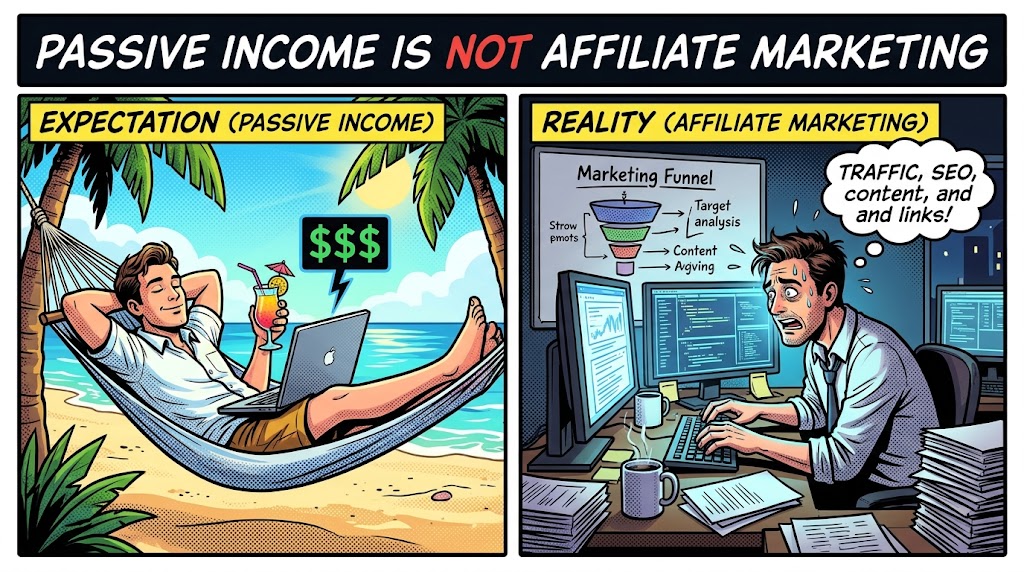
Passive Income Is Not Affiliate Marketing – Here’s Why
Table of Contents
If an online guru or social media influencer told you that affiliate or digital marketing is passive income, I’ve got some news for you.
It isn’t. At least, not in the beginning.
Were they deliberately misleading you? Perhaps.
Were they being overly optimistic? Possibly.
Or maybe they conveniently left out the part about months of unpaid work, learning new skills, spending money, and building a business before seeing any meaningful return.
Before we go any further, let’s get our terminology straight.
Passive Income, Affiliate Marketing, Digital Marketing, and Leveraged Income
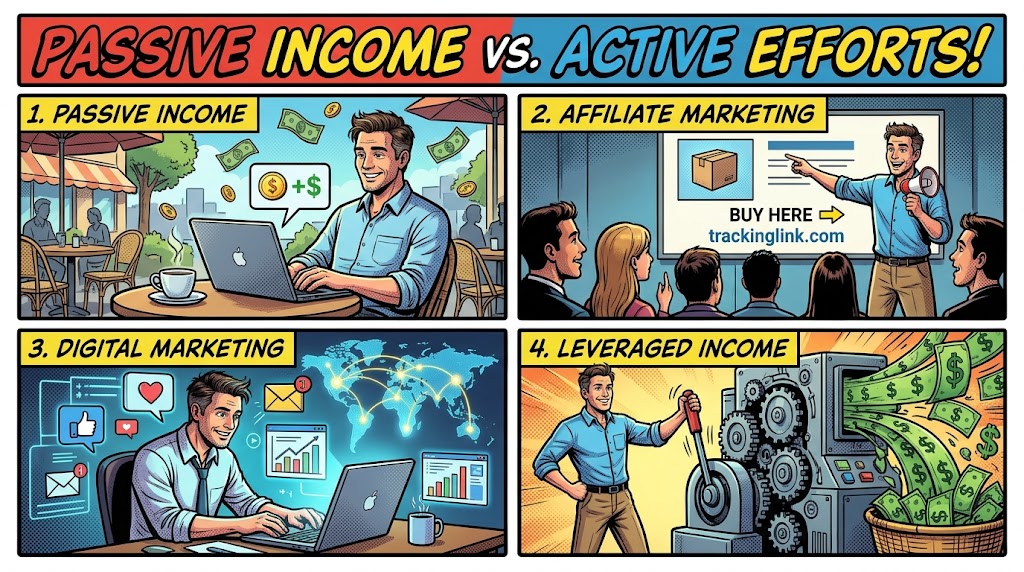
1. Passive Income
Passive income generally refers to money earned with relatively little ongoing effort or direct daily involvement. That doesn’t necessarily mean no work was required to create it.
2. Affiliate Marketing
Affiliate marketing is a business model in which you promote another company’s products or services using a unique tracking link. When someone makes a qualifying purchase through that link, you earn a commission.
3. Digital Marketing
Digital marketing involves using the internet and digital channels, including websites, search engines, email, and social media, to promote products, services, or brands.
4. Leveraged Income
Now we’re getting somewhere!
Leveraged income is money earned by using systems, technology, content, or other resources to multiply the results of your efforts.
Your income is no longer necessarily tied directly to the number of hours you work.
In my opinion, leveraged income is a far more accurate description of what affiliate and digital marketing can become.
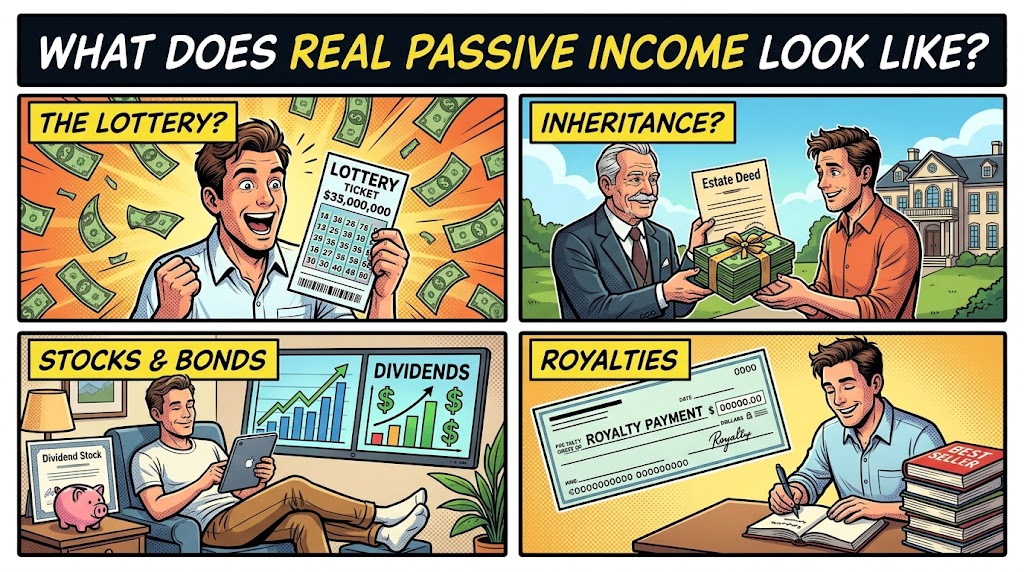
What Does Real Passive Income Look Like?
Let’s start with the obvious.
You could win the lottery!
Your odds of hitting the Powerball jackpot are approximately 1 in 292.2 million. Mega Millions offers similarly astronomical odds.
Not exactly a retirement strategy I’d recommend.
You might have better luck standing outside during a thunderstorm holding a nine-iron.
Then there’s inheritance.
If you’re fortunate enough to inherit substantial assets, a qualified financial professional can help structure investments and distributions that provide income monthly, quarterly, or annually.
There are also traditional investments.
Bonds: Government and corporate bonds can provide scheduled interest payments. Mortgage-backed securities are another possibility, although they carry additional risks.
Stock Dividends: When you purchase shares in a dividend-paying company or exchange-traded fund (ETF), you may receive regular distributions without having to sell your investment.
Sounds pretty good, doesn’t it?
You buy shares, and money shows up in your account.
Who could ask for anything better?
Well, not so fast.
The Clorox Example: Passive Income Still Carries Risk
Consider Clorox (CLX), a well-established company known for its household products.
Clorox is a Dividend Aristocrat, meaning it belongs to the S&P 500 and has increased its regular dividend for at least 25 consecutive years.
In early November 2026, its annualized dividend yield was approximately 5.5%.
That’s an attractive income stream.
But here’s the catch.
A stock can pay a generous dividend while its share price performs poorly. An investor might collect several years of dividends and still experience disappointing overall returns.
And when we compare a stock’s performance against the S&P 500, we need to account for both price changes and reinvested dividends.
The lesson? A dividend is income. It is not protection against investment losses.
Every investment involves some combination of risk and potential reward.
What About Options?
Options can also generate income, particularly through strategies such as covered calls and cash-secured puts.
An option is a financial contract giving its buyer the right, but not the obligation, to buy or sell an underlying asset at a predetermined price under specified conditions.
The seller receives a premium in exchange for taking on contractual obligations.
And those premiums can look mighty enticing on your computer screen!
Until you’re assigned and suddenly find yourself obligated to buy 100 shares of stock, or sell 100 shares you already own.
That can snap you out of your daydream in a hurry.
Options premiums aren’t free money, and options trading isn’t necessarily passive. It requires capital, risk management, and an understanding of the obligations involved.
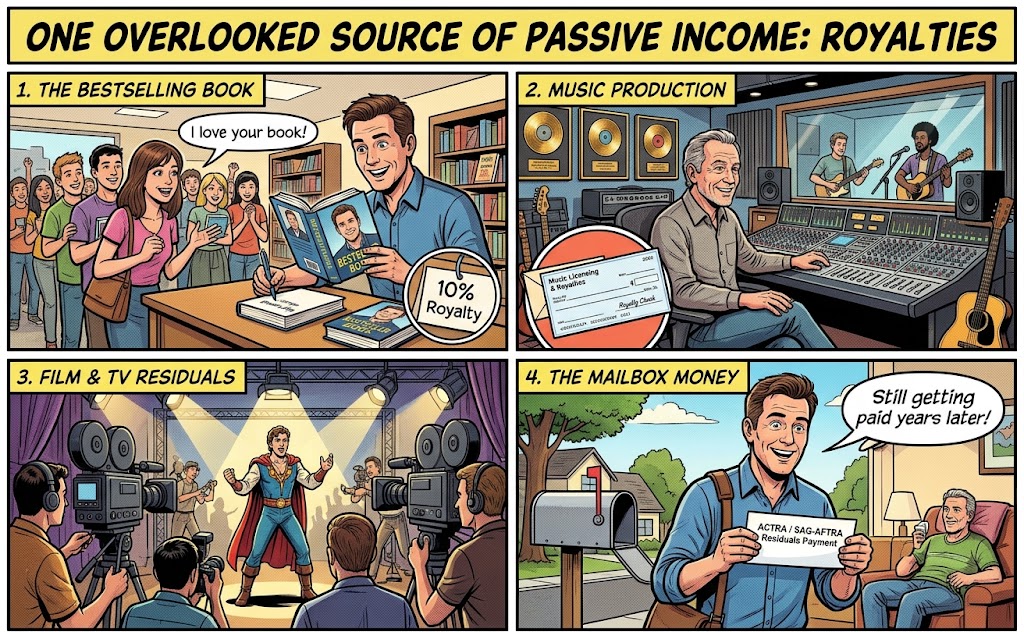
One Overlooked Source of Passive Income: Royalties
Here’s something I find fascinating.
Whenever people discuss passive income, publishing and licensing often get overlooked.
Yet these can be substantial sources of long-term income.
Consider the publishing business.
Suppose I write a bestselling how-to book that retails for $15.
Under a hypothetical publishing agreement paying a 10% royalty on the retail price, I’d receive $1.50 per copy.
Now suppose that book sells 20 million copies.
That’s $300 million in retail sales.
My royalties?
$30 million, before taxes and other contractual considerations.
Not bad for a little writing!
Of course, royalty agreements vary considerably, and selling 20 million books is an extraordinary achievement.
But you get the idea.
And what happens when a successful book develops a following?
Suddenly there’s How-To: The 2027 Edition.
Then How-To for Women.
Then How-To for Teenagers.
Before you know it, the original book has become an entire publishing business.
We’ve all seen it.
I’ve Experienced Royalty Income Personally
Years ago, I worked for a well-known and highly respected music arranger and producer.
This gentleman had worked on many of the songs I listened to growing up.
What amazed me was that he continued receiving royalties from music he’d helped create 40 or 50 years earlier.
Think about that.
Work performed decades ago was still producing income.
I can relate to that on a smaller scale.
I’m primarily a television and film actor. My busiest professional years were between 1985 and 1992.
Although I remain active today, the demand for my acting services isn’t what it once was.
Nevertheless, I still receive residual payments from productions I worked on many years ago.
I don’t have to return to the set or perform those scenes again to receive those payments.
That’s an excellent example of work performed once continuing to generate income years later.
And it’s an important distinction when discussing affiliate marketing.
An Online Business Is Still a Business
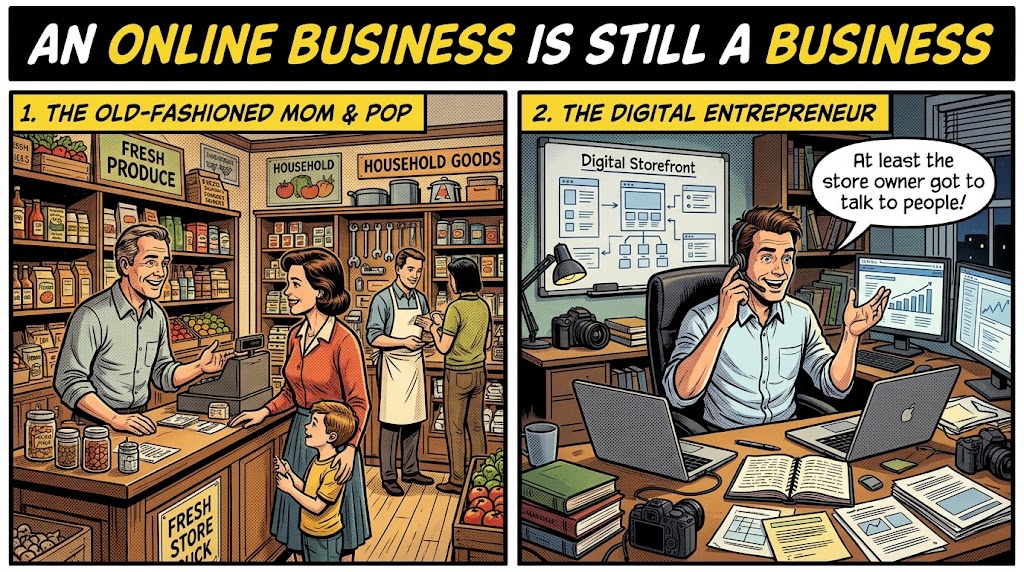
Here’s something the internet marketing crowd doesn’t always emphasize.
An online business has more in common with an old-fashioned mom-and-pop store than you might think.
“Years ago, the mom-and-pop store owner worked twelve hours a day behind a counter. Today, the digital entrepreneur works twelve hours a day behind a computer. At least the store owner got to talk to people!”
Think about it.
Both businesses require time, money, commitment, and the willingness to learn.
Both need customers.
Both must establish trust.
Both can experience months when expenses exceed revenue.
And both require consistency and tenacity if they’re going to survive.
The biggest difference is that a traditional storefront usually requires substantially more upfront capital than a modest online business.
Rent, inventory, insurance, utilities, employees — those expenses add up quickly.
An online business may have lower startup costs, but lower costs don’t automatically mean easier profits.
I know. I’m sounding pessimistic.
But there’s an old saying:
The nice thing about pessimism is that you’re constantly being proven right or pleasantly surprised.
Can Affiliate Marketing Eventually Produce Passive Income?
Absolutely.
But there’s a rather important word missing from many online advertisements.
Eventually.
After you’ve created content, attracted an audience, established credibility, and built systems that work, some of your earlier efforts may continue producing income with less direct involvement.
Here are three ways that can happen.
1. Recurring Commissions and Subscription Sales
Recurring commissions are popular in affiliate marketing.
Here’s how they work.
A customer purchases a subscription-based product or service through your affiliate link.
You receive a commission.
If the affiliate program offers recurring commissions, you may continue getting paid when that customer renews the subscription.
That can become a valuable source of ongoing revenue.
But there’s a catch.
The customer must remain subscribed, the company must continue operating, and the affiliate agreement must continue providing those payments.
This is one more reason to recommend quality products that deliver genuine value.
A dissatisfied customer isn’t likely to stick around.
2. Automated Sales Funnels
A sales funnel is the process that guides potential customers from their first encounter with your content toward a possible purchase.
A well-designed funnel might include a landing page, email follow-ups, useful information, and an eventual product recommendation.
Automation allows parts of that process to operate without your constant attention.
If you’re interested in building automated funnels, visit Home Business Academy https://thehba.app/go?aff_id=18946 now.
HBA provides tools designed to simplify funnel creation, potentially freeing up more of your time to develop content and engage with your audience.
But don’t confuse automation with abandonment.
Funnels still need testing, monitoring, and occasional adjustments.
That’s particularly true in rapidly changing markets such as e-commerce and make-money-online products.
3. Content Channels and Organic Traffic
This is where things get interesting.
Imagine publishing a useful article today.
Six months from now, someone discovers it through a search engine.
They read it, find it helpful, follow one of your recommendations, and purchase a product.
You might earn a commission from work you completed months earlier.
That’s the potential power of organic traffic.
Personally, I believe a quality blog is an important foundation for building a long-term online presence.
That’s why I trust Badass Network https://badassnetwork.com/go/dino4051/ to publish my articles, share ideas, and introduce relevant products and services to potential customers.
I also use multiple social media channels to expand my reach and encourage engagement.
The objective is to build an audience that finds your material useful enough to return, subscribe, and perhaps eventually become customers.
That’s essentially the approach behind the program I’m involved with.
I’m an affiliate for HighTicketLifestyle (HTL) https://thehighticketlifestyle.com/danielo, founded and operated by Justin Temple.
HTL provides training, support, and opportunities to promote products that may generate different types of affiliate commissions.
Justin places considerable emphasis on helping newcomers establish the systems needed to get started.
The idea is to build something that can continue attracting potential customers long after the original content was published.
That’s where affiliate marketing begins to resemble passive income.
But there’s still work involved.
Let’s Be Clear: It Ain’t Passive!
Not when you’re getting started.
And sometimes not even after you’ve been at it for years.
Here’s why.
1. The Upfront Work Can Be Enormous
Creating content.
Building an audience.
Learning search engine optimization.
Understanding email marketing.
Developing technical skills.
Researching products.
Establishing credibility.
The list goes on.
I’m a professional actor, accustomed to working in front of cameras.
Yet yesterday, producing and publishing a 35-second YouTube Short took me approximately three or four hours, from the original idea to the finished upload.
Thirty-five seconds!
Imagine explaining that to someone who believes digital marketing consists of pressing a few buttons and collecting commissions while sitting on a beach.
And I’m still learning.
For many beginners, building a profitable online business can take months or years of consistent effort. Some never achieve profitability.
Unfortunately, certain online gurus conveniently minimize this reality until after you’ve purchased their training.
Question them afterward, and suddenly they start explaining all the work involved.
But don’t you dare call them scammers!
They’re simply infopreneurs.
Some of whom belong to a very exclusive organization:
LOLEs — Lords of Loose Ethics.
Membership apparently has no shortage of applicants.
2. Ongoing Maintenance Never Completely Disappears
Digital marketing changes constantly.
A company you’re promoting might merge, alter its commission structure, or disappear entirely.
Search engines update their algorithms.
Social media platforms change their rules.
Advertising costs fluctuate.
Customer preferences evolve.
And products that were relevant last year may be outdated today.
You have to keep learning and adapting.
That’s business.
3. Active Promotion Still Matters
The famous “set it and forget it” approach is largely a pipe dream.
Audience engagement requires attention.
Content needs updating.
Customers ask questions.
Links break.
Email lists need maintenance.
It’s a little like going to the gym.
Miss a day or two? Probably no big deal.
Miss three or four weeks?
You may begin noticing changes.
And not necessarily the kind you were hoping for.
But Could It Become More Passive Over Time?
Yes.
Maybe.
And that’s the opportunity worth discussing.
Evergreen Content Can Keep Working for You
Evergreen content refers to useful material that remains relevant long after publication.
Examples include practical tutorials, educational articles, instructional videos, and answers to common questions.
An article written two years ago might still attract readers today.
A YouTube tutorial could continue generating views long after its original publication.
An automated email sequence might continue introducing new subscribers to useful information and relevant products.
But evergreen doesn’t mean eternal.
Even your best material needs occasional review to remain accurate.
Another important part of this process is developing a quality email list.
I’ve learned that leads are among the most valuable assets an online marketer can build.
Leads are the capital we marketers trade in.
I use AWeber to help collect and organize leads, manage email communications, and follow up with subscribers professionally.
Click AWeber now https://www.aweber.com/easy-email.htm?id=562049 and take advantage of their free trial offer.
A well-maintained email list gives you a way to maintain relationships with people who have expressed interest in what you offer.
And unlike an audience that exists entirely on a social media platform, your email list is less dependent on the whims of a single algorithm.
Recurring Commissions Can Build Over Time
Subscription-based software and services, often referred to as SaaS, can provide opportunities for recurring affiliate commissions.
If customers remain satisfied and continue their subscriptions, those payments may accumulate over time.
But they’re never guaranteed.
Customers cancel.
Programs change.
Companies discontinue products.
The goal is to develop multiple reliable sources of income rather than depend entirely on one product, company, or marketing channel.
The Real Goal Is Supplemental Income, Not Overnight Wealth
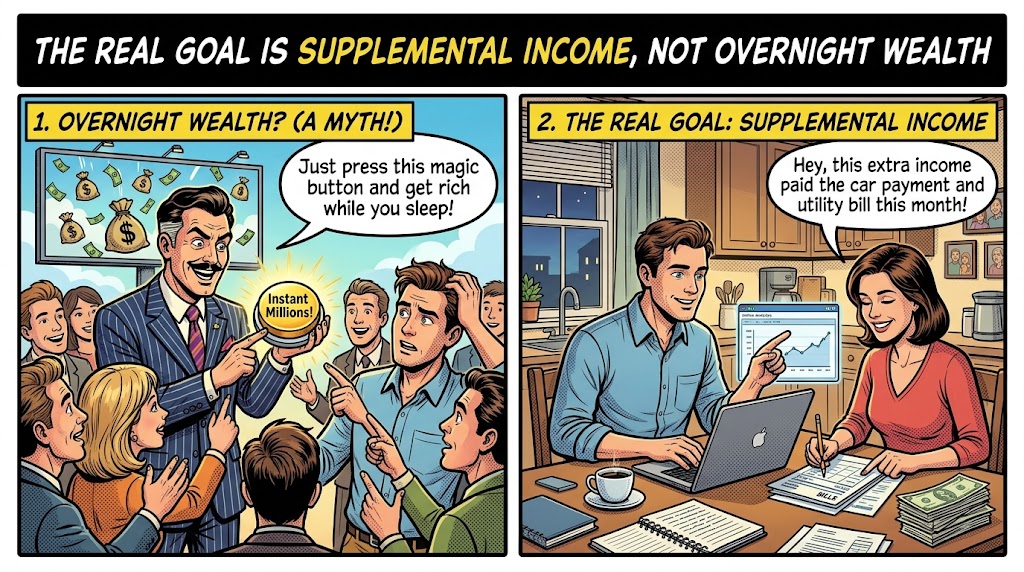
Here’s what I believe newcomers should understand.
During the early stages of affiliate and digital marketing, your priorities should be straightforward:
- Learn useful skills.
- Create valuable content.
- Build trust with your audience.
- Develop an email list of interested subscribers.
- Recommend products you genuinely believe provide value.
- Remain consistent, even when progress seems painfully slow.
Don’t expect instant results.
Don’t confuse automation with a business that operates entirely without you.
And please don’t believe there’s some magical AI button you can press that will suddenly deposit money into your bank account.
There isn’t.
Artificial intelligence can help with research, content development, organization, and productivity.
But it doesn’t eliminate the need for judgment, credibility, customer relationships, or plain old-fashioned work.
Forget The Magic Bullet. Build Something Real.
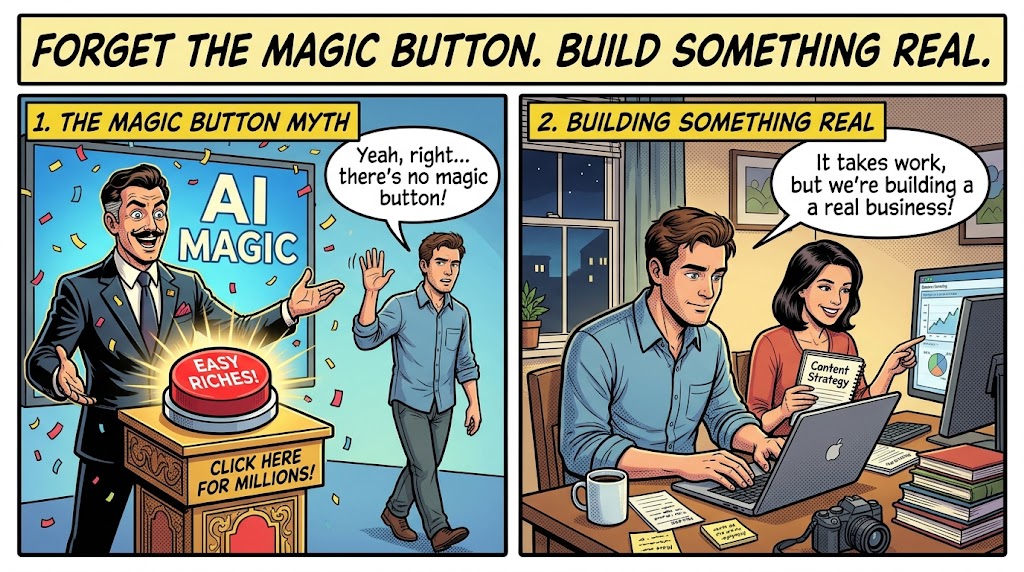
Here’s my final thought.
If you’re looking for a business that makes money while you sleep, understand that you may have to lose a little sleep building it first!
Affiliate marketing isn’t a lottery ticket. It isn’t a guaranteed paycheck. And it certainly isn’t a magic AI button.
But with the right training, realistic expectations, consistent effort, and a willingness to learn, it may become a way to supplement your income — and perhaps eventually generate revenue from work you completed months or even years earlier.
That’s the opportunity that interests me.
I’m building my own online business through HighTicketLifestyle (HTL), founded by Justin Temple. If you’re curious about getting started, take a look at the program and decide whether it’s a good fit for you.
Go to https://thehighticketlifestyle.com/danielo now to see the opportunity afforded affiliates to tap into multiple streams of income.
No overnight riches. No ridiculous promises. Just an opportunity to learn, build, and see where your efforts can take you.
No hype. Just the life I enjoy.
Thanks for reading. Now, if you’ll excuse me, I’ve got a business to build. Apparently, this passive income thing requires actual work!
This post contains affiliate links. If you use these links to buy something we may earn a commission. Thanks.