Customer-Centered Marketing: When Storytelling Goes Too Far

The Hero’s Journey, the Five Cs of Selling, and Why Your Customer Should Be the Star of the Show
1. Nobody Asked for Your Life Story

Imagine this.
You’re interested in starting an online business. You click on a video promising to explain an exciting affiliate marketing opportunity.
You have three perfectly reasonable questions:
What is it? What does it cost? And what can it realistically do for me?
Simple enough.
Unfortunately, you’ve just purchased a front-row ticket to somebody’s autobiography.
First comes the troubled childhood. Then the failed marriage. The financial catastrophe. The friends who didn’t believe in him. The relatives who laughed at his ambitions.
Somewhere around minute 27, our hero experiences a spiritual awakening.
By minute 35, he’s standing beside a Lamborghini, explaining how his life changed forever.
And by minute 40, you’re still wondering what the business actually does.
The prospect came looking for information. He got a documentary.
Welcome to the increasingly popular world of affiliate marketing storytelling, where the seller’s personal journey sometimes receives considerably more attention than the customer’s needs.
Now, don’t misunderstand me.
I’m not suggesting that personal storytelling has no place in sales. Quite the opposite. Personal experiences can establish trust, demonstrate understanding, and make otherwise dry information memorable.
But somewhere along the way, a useful marketing technique became an elaborate performance.
And that raises an important question:
When does the seller’s desire to be understood overshadow the buyer’s need to understand?
That’s what we’re going to explore.
2. How the Hero’s Journey Took Over Affiliate Marketing

Long before online marketing funnels, webinars, and social media advertisements, there was the Hero’s Journey.
In his 1949 book The Hero with a Thousand Faces, mythologist Joseph Campbell explored recurring patterns found in stories across cultures.
The familiar structure involves an ordinary person confronting a challenge, entering unfamiliar territory, encountering obstacles, receiving guidance, and eventually experiencing some form of transformation.
Hollywood embraced variations of this storytelling structure.
So did advertisers.
And eventually, online marketers discovered its emotional appeal.
The typical affiliate marketing version goes something like this:
I was struggling financially. Nothing worked. I tried everything. Then I discovered a remarkable system. I followed the training, overcame my obstacles, and transformed my life.
There’s nothing inherently dishonest about that narrative.
If the experience is genuine and relevant, it may help someone understand how a product or service works.
But problems arise when the storyteller assumes that his personal transformation must be the centerpiece of every sales presentation.
Consider Star Wars.
Luke Skywalker needed Obi-Wan Kenobi’s guidance.
He didn’t need Obi-Wan’s 45-minute autobiography before learning how to use a lightsaber.
The mentor’s value came from helping Luke confront his challenges.
Not from demanding admiration for his own accomplishments.
That’s a distinction some modern marketers seem to have forgotten.
The customer isn’t necessarily interested in becoming an audience member for your personal triumph.
The customer has a journey of their own.
And your responsibility is to determine whether what you’re offering can genuinely help them along the way.
3. When Authenticity Becomes Too Much Information

Authenticity has become one of the most frequently repeated words in digital marketing.
Be yourself.
Share your struggles.
Reveal your vulnerabilities.
Tell people what you’ve overcome.
It’s generally reasonable advice.
People often prefer dealing with recognizable human beings rather than faceless corporations or automated sales machines.
But authenticity has a potential downside.
Self-revelation can be emotionally rewarding for the person doing the revealing.
Telling our stories allows us to revisit difficult experiences, explain our decisions, and sometimes receive admiration or validation.
That can be cathartic.
But a sales presentation isn’t a therapy session.
And the prospect didn’t necessarily volunteer to become your therapist.
The distinction is straightforward:
Useful self-revelation helps the customer understand something important. Excessive self-revelation asks the customer to become emotionally invested in the seller.
Consider two approaches.
Approach A:
“I struggled for years. Nobody believed in me. I failed repeatedly. Then one day I discovered the secret that changed everything.”
Approach B:
“I’ve tried online business opportunities that appeared inexpensive until additional costs started showing up. That experience taught me to investigate the total expenses before recommending a program.”
Both statements reveal personal experience.
But the second immediately offers the prospect something useful.
It identifies a potential problem and explains a lesson learned.
The first might eventually lead somewhere valuable.
Or it might lead to another 35 minutes of autobiography.
There’s another danger worth mentioning.
Some marketers have learned to manufacture vulnerability.
The emotional pauses. The dramatic music. The perfectly rehearsed story about losing everything.
When personal hardship becomes a calculated technique for pressuring someone into buying, authenticity has left the building.
A sad story might earn you sympathy. It doesn’t automatically earn you credibility.
And sympathy isn’t a substitute for a good product.
4. Your Customer Is the Hero. You’re Not.

Here’s where I believe affiliate marketing storytelling needs a fundamental change.
Every prospective customer has personal ambitions, frustrations, fears, and motivations.
Some are obvious.
Others are deeply private.
A retired gentleman might tell you he wants to earn another $1,000 per month.
That’s his stated objective.
But what’s motivating it?
Perhaps he wants to reduce financial pressure on his household.
Perhaps he wants to help his grandchildren.
Perhaps he wants to prove that retirement doesn’t mean the end of personal achievement.
Or perhaps he simply wants enough extra money to enjoy a few luxuries without worrying about the household budget.
Different people.
Different motivations.
Same stated financial goal.
And here’s something that interests me enormously:
The most powerful motivations are sometimes the ones people are least comfortable admitting publicly.
We all have people whose opinions matter to us.
We have ambitions that go beyond dollars and cents.
We may want recognition, independence, security, or the satisfaction of accomplishing something difficult.
Sometimes we don’t fully understand our own motivations until someone asks the right question.
That’s where thoughtful selling becomes something more than delivering a polished presentation.
Instead of immediately explaining your personal success, consider asking:
“What would an additional source of income actually change in your everyday life?”
Or:
“What has been your biggest frustration with the opportunities you’ve investigated?”
Or simply:
“What are you hoping to accomplish?”
Then listen.
You may discover that the prospect isn’t particularly interested in becoming wealthy.
They might be interested in becoming independent.
And those aren’t necessarily the same thing.
Of course, this isn’t an invitation to pry into someone’s private life.
The prospect doesn’t owe you an emotional confession.
The objective isn’t to make customers reveal their deepest motivations to you. It’s to help them become more aware of what matters to them.
And whatever they choose to share should never become ammunition for emotional manipulation.
The Importance of a Mentor Who Understands Your Goals
This philosophy also applies to the training programs we choose.
When someone enters affiliate marketing, they may need more than software and instructional videos.
They may need encouragement, guidance, and someone willing to help them work through problems.
That’s one reason I became an affiliate for High Ticket Lifestyle (HTL).
My experience with its training and mentorship has been extremely positive.
I appreciate having access to people who take an interest in helping members understand the business rather than simply handing them a collection of tools.
HTL offers education, guidance, and different ways to participate in affiliate marketing, with features and costs depending on membership level.
In marketing terminology, someone who enthusiastically advocates for a brand because of a positive personal experience is sometimes called a brand evangelist.
That’s how I feel about HTL.
My enthusiasm comes from my satisfaction with the support and educational approach—not from any promise that everyone who joins will make money.
Affiliate marketing requires effort, and results vary.
A good mentor doesn’t make himself the hero of your journey. He helps you develop the skills to pursue your own goals. Click here to take a look for yourself https://thehighticketlifestyle.com/danielo
And remember:
Nobody wakes up in the morning hoping to become a supporting character in somebody else’s success story.
5. The Five Cs of Selling: What Old-School Copywriting Still Gets Right

Long before marketers were discussing algorithms, artificial intelligence, and elaborate sales funnels, successful direct-response copywriters understood a fundamental principle:
The prospect’s interests come first.
The methods of reaching customers have changed dramatically.
Human motivations haven’t changed nearly as much.
People still want security, independence, recognition, convenience, and peace of mind.
And the old-school principles of effective communication remain remarkably useful.
Let’s revisit what I call the Five Cs of Selling.
C #1: CLARITY
What does your offer do?
How does it work?
Who is it designed to help?
And how might it improve the customer’s present circumstances?
You should be able to answer those questions without requiring the prospect to decipher technical jargon or sit through an elaborate motivational presentation.
Clarity also requires understanding the customer’s problem.
Effective communication isn’t simply delivering a polished sales pitch.
It’s asking questions, listening carefully, and explaining the offer in terms that matter to the person receiving it.
If you cannot clearly explain what you’re selling, perhaps you don’t understand it well enough yourself.
C #2: CONCISE
Remember the elevator pitch?
The idea was to communicate the essence of your offer during a brief elevator ride.
I’m not suggesting that every sales presentation should last 20 seconds.
Complex products deserve thorough explanations.
But you should be able to communicate the central idea in approximately 20–30 seconds.
A concise introduction might explain who the product helps, what problem it addresses, and why someone might want to learn more.
Then provide the additional information the prospect requests.
As Shakespeare wrote:
“Brevity is the soul of wit.”
And as another old saying reminds us:
“When all is said and done, there’s more said than done.”
Sometimes the greatest improvement you can make to a sales presentation is removing half of it.
C #3: COMPELLING
Words matter.
Strong verbs create movement.
Specific nouns give readers something concrete to understand.
Compare these statements:
“This tool can help you save time.”
And:
“This tool automates repetitive follow-up emails, reducing the time you spend responding manually.”
The second statement is more compelling because it explains how the benefit occurs.
Consider home security.
“Our system offers excellent protection.”
That’s pleasant enough.
But a more meaningful explanation might be:
“Our system sends an alert when a monitored door or window opens, allowing you to respond quickly.”
Specific benefits are more persuasive than vague superlatives.
Of course, stronger language must never become an excuse for exaggerated promises.
And if you’re targeting highly competitive, achievement-oriented customers, you might be tempted to announce:
“This system will SMASH your competition and give you the ammunition to claim victory!”
All right.
Perhaps I’m getting a little carried away.
You get the picture.
Compelling communication should make the benefit vivid without making the promise unbelievable.
C #4: CREDIBLE
Trust is earned.
Not demanded.
Not manufactured.
And certainly not established merely by displaying expensive automobiles, luxury watches, or impressive-looking income screenshots.
Credibility requires accurate information, reasonable expectations, and a willingness to discuss limitations.
The old advertising expression was:
“Sell the sizzle, not the steak.”
There’s some wisdom in emphasizing benefits.
But today’s skeptical customer may also want to know where the steak came from, how much it weighs, and whether the advertised price includes the side dishes.
If a prospect identifies a flaw in your product, address it.
If the program requires additional monthly expenses, disclose them.
If results depend heavily on individual effort, experience, or market conditions, explain that.
Honesty about a product’s limitations can strengthen credibility rather than weaken it.
And never promise results you cannot substantiate.
C #5: CALL TO ACTION
A good sales presentation should lead naturally toward a decision.
But that decision belongs to the customer.
Explain the available options.
Provide accurate pricing.
Answer questions.
Offer a clear next step.
And respect the prospect’s independence.
Not everyone is ready to buy.
Not everyone should buy.
And sometimes the most professional response to a prospect is:
“Based on what you’ve told me, I’m not sure this is the right fit for you.”
Never shame someone for declining an offer.
Dale Carnegie emphasized the importance of allowing others to save face.
That principle remains valuable.
I’ve seen situations where someone declined an opportunity but later recommended it to a friend or family member who was a better fit.
The original prospect said no.
Someone else eventually said yes.
A respectful conversation can preserve a relationship long after the immediate sales opportunity has passed.
And notice something about these Five Cs.
Not one prohibits personal storytelling.
A relevant experience can improve clarity.
A short anecdote can make a presentation compelling.
An honest admission can establish credibility.
But storytelling should support these principles.
Not replace them.
6. The Three Questions Your Prospect Really Wants Answered
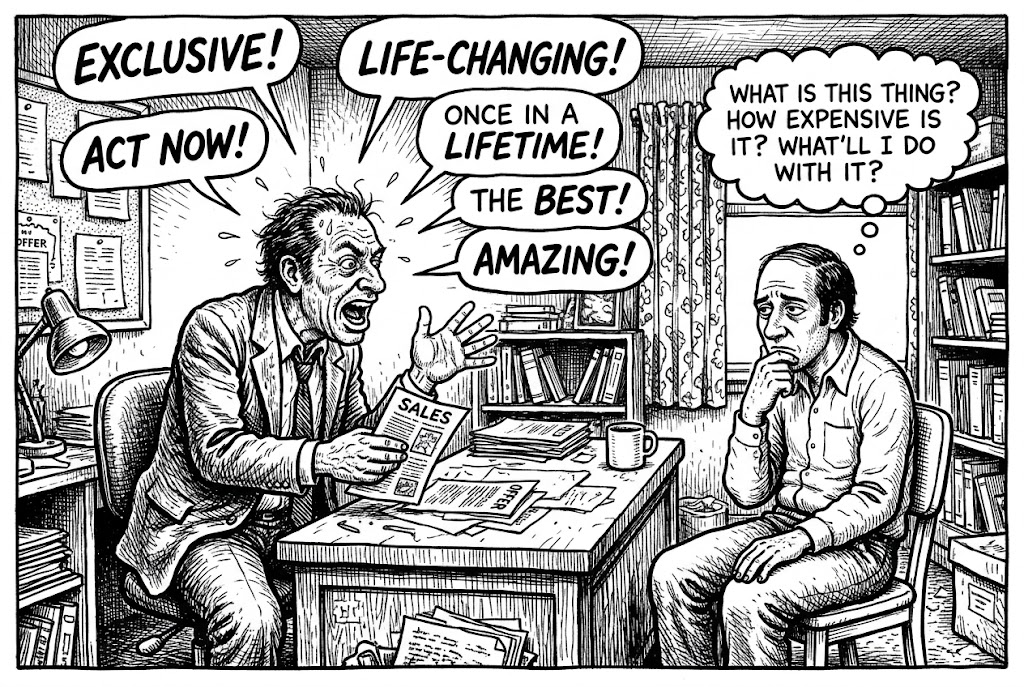
Let’s return to our unfortunate viewer, still waiting for the online business presentation to get to the point.
What does that person actually need?
Usually, three fundamental answers.
First: What is it?
Explain the business model, product, or service.
Is it affiliate marketing?
Does it involve selling digital products?
Are there recurring subscriptions?
Will the customer need a website, email service, or additional software?
Don’t hide the basic explanation behind mysterious phrases such as “revolutionary wealth system.”
Second: What does it cost?
This includes more than the initial enrollment price.
Discuss required tools, recurring expenses, optional upgrades, advertising costs, and other reasonably foreseeable expenditures.
A $57 entry fee doesn’t necessarily mean someone can operate the entire business indefinitely for $57.
Prospects deserve to understand the distinction.
Third: What can it realistically do for me?
This is where the seller should explain potential benefits without manufacturing unrealistic expectations.
What skills are required?
How much time might be involved?
What ongoing work is necessary?
What limitations should the prospect understand?
For an older adult investigating affiliate marketing for the first time, these questions can be particularly important.
Many are not interested in becoming overnight millionaires.
They want straightforward information about whether an opportunity fits their finances, abilities, and lifestyle.
Don’t Keep Your Prospects Waiting
Once someone expresses interest, timely communication becomes important.
An unanswered question can easily become a lost opportunity.
But there’s a difference between following up helpfully and relentlessly pursuing someone who has already said no.
That’s where an email marketing platform such as AWeber can be useful.
Autoresponders can organize subscribers, deliver requested information, and help maintain consistent communication.
They can also reduce the amount of repetitive work involved in responding to routine inquiries.
Used thoughtfully, email automation supports customer service.
Used carelessly, it becomes another source of unwanted messages.
The objective is to automate useful communication—not automate the process of annoying people.
And remember, an autoresponder can deliver an email.
It cannot genuinely listen to the person reading it. Go to AWeber now https://www.aweber.com/easy-email.htm?id=562049 and get started responding to your prospects professionally.
Respecting the customer’s intelligence and time is one of the simplest ways to establish trust.
7. Five Warning Signs Your Story Has Gone Too Far

How do you know when personal storytelling has crossed the line?
Here are five warning signs worth recognizing.
1. The Therapy-Session Shift
You’re doing nearly all the talking.
The prospect is politely nodding.
Instead of discussing their needs, you’re describing your personal struggles in extraordinary detail.
At some point, the sales presentation has become an emotional monologue.
2. Irrelevant Personal Information
Your divorce, family disagreements, financial hardships, or political opinions may be important parts of your life.
But are they relevant to the product?
If not, consider leaving them out.
3. The Never-Ending Origin Story
Every question somehow leads back to your personal transformation.
The prospect asks about pricing.
You explain your childhood.
They ask about technical support.
You describe the moment you discovered your purpose.
Eventually, they stop asking questions.
4. Manufactured Vulnerability
A rehearsed tragedy is presented as though it were an unexpected emotional confession.
The goal isn’t understanding.
It’s sympathy.
And sympathy is being used to encourage a purchase.
That’s a dangerous direction for any marketer.
5. Attacking Previous Companies or Competitors
Discussing genuine product shortcomings can be useful.
But repeatedly criticizing former mentors, business partners, or competing programs merely to elevate yourself is another matter.
Explain what you learned.
Identify the practical warning signs.
Then return to helping the customer.
Here’s a useful rule for personal storytelling:
Problem → Experience → Lesson → Customer Benefit.
Tell the relevant part of your experience.
Explain what you learned.
Show why that lesson matters to the prospect.
Then return the conversation to them.
No violins required.
8. The Tools Behind Customer-Centered Marketing

Understanding your customer is only half the job.
You also need tools that allow you to communicate your message clearly and make the buying process as straightforward as possible.
Unfortunately, some online marketing platforms seem determined to make simple tasks unnecessarily complicated.
I’ve encountered funnel-building software that practically requires an engineering degree.
Some systems are so confusing that graduates of Stanford and MIT might be tempted to throw their laptops against the wall.
Maybe that’s an exaggeration.
A slight one.
But you understand the frustration.
Why Simplicity Matters: Home Business Academy
That’s one reason I appreciate Home Business Academy (HBA).
In my experience, its funnel-building approach is relatively straightforward, and its educational resources help explain important aspects of online marketing.
For beginners, simplicity matters.
A complicated system can discourage someone before they’ve even had an opportunity to learn the fundamentals.
The purpose of a marketing funnel should be to guide prospects through a logical sequence of information.
It shouldn’t become an obstacle course.
Of course, every platform has limitations, and users should confirm that its features meet their particular needs.
The best tool isn’t necessarily the one with the most features. It’s the one that helps you accomplish the task without unnecessary confusion.
I love Home Business Academy for their simplicity and price point. Go to https://thehba.app/go?aff_id=18946 and take advantage of everything they have to offer the affiliate/digital marketer.
There’s a larger lesson here.
The tools we choose should support the customer’s experience.
They should make information easier to find, questions easier to answer, and decisions easier to understand.
If your customer needs a roadmap, three passwords, and a spiritual awakening just to discover what you’re selling, perhaps your marketing needs work.
9. The Human Element: Don’t Throw the Baby Out With the Bathwater

After everything we’ve discussed, you might conclude that the safest approach is to eliminate personal storytelling entirely.
I wouldn’t recommend that.
We’ve all encountered marketing that feels as though it was produced by a machine.
Perfectly organized.
Perfectly polished.
Perfectly optimized.
And completely devoid of personality.
That’s not necessarily an improvement.
People appreciate warmth, humor, honesty, and recognizable human experience.
A short personal anecdote can communicate something that a technical explanation cannot.
An honest admission of a mistake can make a recommendation more credible.
A little humor can make a difficult subject easier to understand.
The problem isn’t self-revelation.
The problem is self-revelation without relevance.
Something can be completely authentic and still be irrelevant to the person listening.
You can tell the absolute truth about your life and still waste a prospect’s time.
Conversely, a carefully chosen 30-second experience can provide valuable context.
Here’s the distinction:
Authenticity asks: “Is this true?”
Relevance asks: “Why should the customer care?”
Effective marketing needs both.
Creating Content People Actually Want to Read
There’s another important consideration.
Even the most customer-centered message accomplishes very little if nobody encounters it.
When selling online, how do you attract readers?
How do you organically develop an audience?
And how do you encourage people to return?
Blogging, search engine optimization, and useful educational content can all contribute to that process.
That’s where Badass Network fits into my own marketing activities.
I use its blogging environment to publish articles, organize information, and create content intended to answer questions people are already asking.
Good content should accomplish more than attracting visitors.
It should give those visitors a reason to stay.
A useful article can explain a problem, compare alternatives, provide practical guidance, or help someone decide what to investigate next.
Organic audience growth generally takes time. Publishing articles doesn’t guarantee traffic, rankings, or sales.
But consistently producing helpful, original material can support a longer-term marketing strategy.
The goal isn’t simply to attract eyeballs. It’s to earn the attention of people who may genuinely benefit from what you’re sharing.
You need to go to https://badassnetwork.com/go/dino4051/ to see how easy they’ve made it for us to get our content out there and most importantly, get it seen !
And remember, not every customer wants the same relationship with a seller.
Some enjoy hearing personal stories.
Others prefer direct comparisons, specifications, and pricing.
The thoughtful marketer pays attention to those differences.
A compelling story may open the door.
But useful information gives the customer a reason to walk through it.
10. Tell Less. Help More.

Let’s return one final time to the Hero’s Journey.
Perhaps the biggest mistake marketers make isn’t telling personal stories.
It’s assuming that their own story must be the most important one in the room.
Every customer has a life beyond the sales presentation.
They have responsibilities, relationships, ambitions, and private motivations.
They may be trying to improve their financial circumstances.
They may want greater independence.
They may be searching for a new challenge.
Or they may simply want to solve a practical problem without spending an entire afternoon listening to someone else’s autobiography.
And here’s what I find particularly interesting.
The most important story in a sales conversation may be the one the customer never tells you.
You don’t necessarily know whom they’re trying to impress.
You don’t know what private disappointment they’re hoping to overcome.
You don’t know what accomplishment would make them feel genuinely proud.
And you don’t have to know every intimate detail.
Your responsibility is to listen, ask useful questions, provide honest information, and respect their decisions.
If a personal experience helps accomplish that, share it.
If it doesn’t, save it for another occasion.
The next time someone asks about your business, try something revolutionary.
Answer their question.
Explain the product.
Discuss the costs.
Describe the benefits and limitations.
And give them the freedom to decide whether it fits their circumstances.
Because the purpose of telling your story isn’t to convince the customer that you’re a hero.
It’s to help them decide whether you can play a useful part in theirs.
And perhaps that’s the most important lesson of all:
The best marketing story isn’t necessarily the one that makes people admire you. It’s the one that helps them.
Affiliate Disclosure
This article contains affiliate recommendations. If you purchase a product or service through one of my affiliate links, I may receive a commission at no additional cost to you. I recommend programs and tools based on my own experiences and opinions. Results vary, and no income or business success is guaranteed.