I Ordered Certainty. It Was Supposed to Arrive Three Business Days Ago.
In an age of instant gratification, I have become a dreadful waiter. Not in a restaurant-waiter kind of sense, although there are a few stories lurking in the back of my mind for a future blog on that topic.
I am talking about the godforsaken act of waiting.
Ever since I was old enough to understand the concepts of patience and waiting, both featured with alarming regularity in my parents’ advice. Hearing those words, however, did absolutely nothing to improve my ability to practise either.
Fifty years later, very little has changed.
When I recently caught myself feeling unusually agitated while waiting for information about my dad’s estate, I realised something had shifted. I wasn’t simply impatient. I had somehow started expecting the world to move at the same speed as the technology I now rely on every day.
When I send an email, I expect a reply before I take the last sip of my coffee. Not because I think I am especially important. I know I’m not. I suspect many of us have become like this, accustomed to a world where almost everything happens instantly.
It starts in the kitchen.
Not all that long ago, we lit a fire before we could even think about boiling a kettle. Water took time. Cooking took time. Life had a built-in rhythm that simply couldn’t be hurried.
Now I flick a switch and wonder why the water isn’t boiling already.
We sit on the couch, order something online and often have it on our doorstep the very next day. We have a question and type it into Google. An answer appears in seconds and, because it required so little effort to obtain, often disappears from memory just as quickly.
Then there is AI.
After Dad died, I spent hours using it to untangle probate, wills and the seemingly endless list of things that need to happen after somebody leaves this world. It was like having an extraordinarily patient teacher sitting beside me, calmly explaining each step while I frantically scribbled notes.
The strange part wasn’t how quickly AI could help me.
It was what happened afterwards.
Somewhere along the way, I had started expecting the rest of life to operate at the same speed.
The nursing home didn’t. The funeral home didn’t. The solicitor certainly didn’t.
AI had already organised next Tuesday while everyone else was still trying to locate Monday.
That discovery has been quietly bothering me ever since.
AI had given me the map. Humans still had to walk it.
Nothing came together the way I had imagined. The beautifully organised, bullet-pointed list AI had calmly laid out for me quickly dissolved into a tangled mess of conversations, misunderstandings and waiting.
The funeral home stopped communicating altogether, sending me into an entirely unreasonable thought spiral that somehow ended with my father’s ashes being scattered by his estranged wife into a compost heap somewhere.
Anxiety has a remarkable imagination.
The first solicitor I approached couldn’t represent us because of a conflict of interest. The second was wonderfully willing to help but had accidentally typed my email address incorrectly, which delayed everything by almost a week.
It is surprisingly difficult to receive legal advice when your solicitor cannot actually email you.
Then the executor of Dad’s will turned out to be the executor of the wrong will. The will found in Dad’s room was not the one governing the estate. A new executor first needed to be appointed through probate before anything else could happen.
Including the release of Dad’s ashes.
You can see why a generous glass of red wine started looking less like an indulgence and more like a perfectly sensible administrative tool.
The round-and-round-in-circles phenomenon is not new. The difference this time was that AI had already shown me how the story should unfold.
Reality simply refused to follow the script.
Eventually, it occurred to me that my frustration wasn’t really with the funeral home, the solicitor or probate.
It was with reality for refusing to keep up.
That realisation made me wonder how many other parts of my life I have outsourced to instant feedback.
The Hidden Cost of Instant Gratification
Writing, for example.
I write because it helps me understand the world. Publishing, however, is a completely different beast. The moment I press “Publish”, I immediately start looking for signs that what I have written is not complete rubbish. I hope people are reading. I hope they are nodding. I hope someone, somewhere, recognises themselves.
Apparently, imagining their nodding is not enough.
I want audible applause.
It turns out I have also become quite good at giving patient advice to other people.
I regularly tell people that if they decide to build a business, they need to think in years, not months. Building anything worthwhile takes time. Quiet consistency beats frantic effort every single time.
I genuinely believe that. Then I open my spreadsheet, hoping the evidence has arrived early.
For me, that lesson currently arrives through LiveGood. I genuinely believe in the company and its products. Anyone already buying supplements should at least compare the quality and prices for themselves.
The real lesson, though, has very little to do with the business.
It is watching my own impatience unfold.
Apparently, patience is much easier to recommend than it is to practise.
And then there is my body.
My mind seems convinced it can issue instructions like an overenthusiastic project manager.
“Right then. We have changed our eating habits. I expect visible improvements by Thursday.”
My body, meanwhile, appears not to have attended the meeting.
Instead of trusting that time might actually be part of the process, I go looking for evidence: less fat, more muscle, better skin, smaller numbers.
Always proof.
Always now.
My nervous system seems caught between two very different worlds.
One world happily embraces faster internet, faster shopping, faster answers, faster transport and increasingly powerful AI that can help us dissect complex questions in seconds.
The other still insists on operating at human speed.
We cannot process thoughts faster simply because AI produces a page-long analysis in a few seconds. I still find myself manually writing out the essence of what I have learnt. I need to sit with it, circle things, argue with it and let the ideas settle before they become part of me. I realised recently that this is exactly what I explored in What Actually Changes When Curiosity Returns – the point where collecting answers becomes less important than letting them reshape how we think.
Manifest AI has become a sparring partner in many areas of my life, but no matter how profound the reflection, my nervous system cannot simply read it and declare the work complete.
The real work continues after the answer arrives. That part still belongs to me.
I cannot write faster simply because the tools are faster. I cannot build trust faster, and I certainly cannot force my body to adapt more quickly to the confusing hormone-induced festival that is menopause. Grief does not move because I would prefer it to, and community is still built one solid conversation, one act of generosity and one shared experience at a time.
Some parts of life simply refuse to participate in our urgency.
And when those two worlds collide — when speed and impatience run headfirst into contemplation and internal digestion — I return to what feels solid.
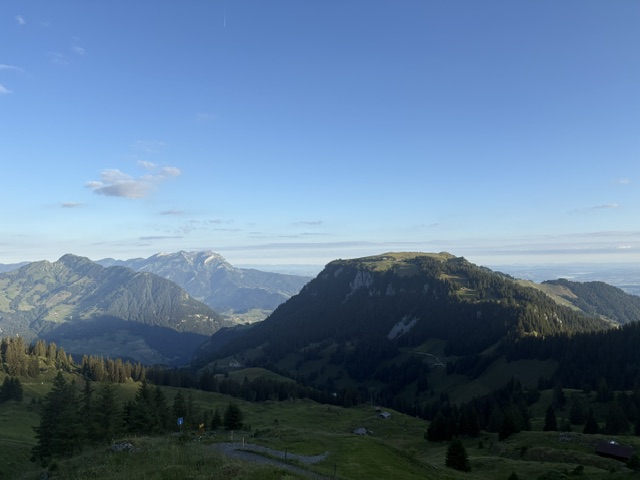
A hike in the mountains.
A walk along the sea.
The landscape depends on which side of the world I am calling home at the time.
I think I keep returning because those places refuse to hurry just because I do. The mountains have never once apologised for taking so long to become mountains. The sea has no interest in my spreadsheet. The forest will not hurry because I have sent another email.
Nothing there responds faster because I refresh the page.
Perhaps that is why I need those places. They bring me back to centre, from where I can begin building my life again at a pace that is actually sustainable.
I still use AI every day, and I will probably ask it something tomorrow morning.
This is not an article about abandoning technology. I am far too attached to my AI sparring partners for that, and switching them off now would probably leave me wandering around the house asking the kettle for strategic guidance.
It is simply an acknowledgement that we are being trained to expect instant gratification in every part of our lives, when we have never really operated that way.
Bodies need time.
Trust needs time.
Grief needs time.
Ideas need time.
Businesses need time.
People need time.
Certainty was not delayed.
It was simply never available with next-day delivery.
One thing I’m still wondering…
What are you still waiting for permission to believe about yourself?
Mine, apparently, is that I can trust the process before the spreadsheet agrees.
What about you?
