How the LiveGood Compensation Plan Actually Works
How the LiveGood compensation plan works is simpler than most people think. This article explains exactly how the LiveGood compensation plan works, step by step, without hype or exaggerated income claims, so you can understand it clearly before deciding anything.
If you’ve ever tried to understand the LiveGood compensation plan and ended up more confused than when you started, you’re not alone.
Most explanations either:
- Throw big income numbers at you
- Assume you already understand matrices
This is neither.
This is the calm version.
I’ve written separately about why I chose this model in the first place — this piece focuses purely on how it works.
How the LiveGood Compensation Plan Works: The Structure
To understand how the LiveGood compensation plan works, you first need to understand the structure.LiveGood uses a 2×15 matrix. If you’re unfamiliar with matrix compensation structures in general, here’s a neutral overview of how matrix plans work.
That means:
- You can have 2 people directly under you
- Each of those 2 can have 2
- Then 8
- Then 16
- And so on
Each level doubles.
There are 15 levels total.
If every position were filled, the matrix would contain:
65,534 people
That is the full capacity of a 2×15 matrix.
2×15 Matrix Breakdown
A 2-wide matrix expanding across 15 levels.
| Level | Positions on This Level | Cumulative Total |
|---|---|---|
| 1 | 2 | 2 |
| 2 | 4 | 6 |
| 3 | 8 | 14 |
| 4 | 16 | 30 |
| 5 | 32 | 62 |
| 6 | 64 | 126 |
| 7 | 128 | 254 |
| 8 | 256 | 510 |
| 9 | 512 | 1,022 |
| 10 | 1,024 | 2,046 |
| 11 | 2,048 | 4,094 |
| 12 | 4,096 | 8,190 |
| 13 | 8,192 | 16,382 |
| 14 | 16,384 | 32,766 |
| 15 | 32,768 | 65,534 |
| Maximum Matrix Size | 65,534 Positions | |
Why Do People Say 8,190?
Because at the starting rank, you are paid on the first 12 levels of the 2×15 matrix.
If you count how many people fit into 12 levels of a 2× matrix, the total is:
8,190 people
Each active member pays $9.95 per month.
You earn $0.25 per active member per month inside your paid levels.
So:
8,190 × $0.25 = $2,047.50 per month
That is the maximum possible matrix income at the unranked level.
Two different numbers:
- 65,534 = full matrix size
- 8,190 = number of people inside the first 12 paid levels
One describes structure.
The other describes what you are paid on at entry rank.
How Placement Works
When someone joins, they are placed in the next available open position in your matrix.
The system fills positions:
- Left to right
- Top to bottom
It follows structure. It follows geometry.
You always keep enrollment credit for the people you personally enroll.
But their physical position in the matrix is determined by structure — not by you choosing where they sit.
This means:
You can personally enroll 10, 30 or 500 people. You can enroll as many people as you like, there is no given limit.
Only 2 can sit directly under you (because it is a 2× matrix).
The rest are placed in the next available open positions below, according to the structure.
What Is Spillover?
Spillover happens when people above you enroll members and open positions in your matrix are filled as a result.
Your matrix is not isolated. It sits inside a larger structure above you. As your upline fills positions in their matrix, some of those placements naturally extend downward into yours.
It is part of the design.
You benefit when your team grows.
But waiting for spillover alone is slow.
Builders build.
Now: How Money Starts Moving
There are four main ways money moves in this plan.
We’ll take them one by one.
1. Fast Start Commissions (One-Time Payment)
When someone joins, two things can happen.
They can join as:
- A Member only
- A Member + Affiliate
Here is how the payment works.
If someone joins as a Member only:
They pay $9.95 for the first month.
You receive $5 one-time commission.
Paid the following week.
If someone joins as a Member + Affiliate:
They pay:
- $9.95 membership
- $40 affiliate fee
You receive:
- $5 from the membership
- $20 from the affiliate fee
Total = $25 one-time commission
Paid the following week.
Important:
Fast Start is paid once when someone joins.
It does not repeat each month.
Matching on Fast Start
When people you personally enrolled begin enrolling others, you receive percentage bonuses on their Fast Start commissions.
The depth and percentage depend on rank.
As your rank increases, you can earn smaller percentages on deeper levels (up to 10 levels).
Because Fast Start is one-time, these matching bonuses are also one-time.
Simple Summary
Fast Start = one-time payment when someone joins.
- $5 if they join as member
- $25 if they join as member + affiliate
- Percentage matches when your team enrolls
Paid weekly.
Not recurring.
2. Matrix Commissions (Recurring Monthly Income)
This is the monthly part.
Every active member inside your paid levels generates:
$0.25 per month
It does not matter:
- Who enrolled them
- Where they came from
- Whether they are your personal referral
If they sit inside your paid levels and their membership is active, you are paid.
Simple Examples
If 100 active members are inside your paid levels:
100 × $0.25 = $25 per month
If 1,000 active members are inside your paid levels:
1,000 × $0.25 = $250 per month
More active members = more monthly income.
When Does Matrix Pay Start?
Month 1 pays Fast Start.
Matrix and Matching commissions begin in the member’s second month.
Example:
If someone joins in December:
- December → Fast Start
- January → no Matrix pay yet
- February → first Matrix and Matching commissions are paid
Matrix and Matching commissions are paid the first week of the following month for the previous month’s activity.
How Many Levels Are You Paid On?
At entry rank, you are paid on the first 12 levels.
Higher ranks unlock deeper levels — up to all 15.
What Is Required To Qualify?
There are no:
- Personal volume requirements
- Mandatory product purchases
- Monthly sales quotas
Your membership simply needs to be active.
That is the only requirement.
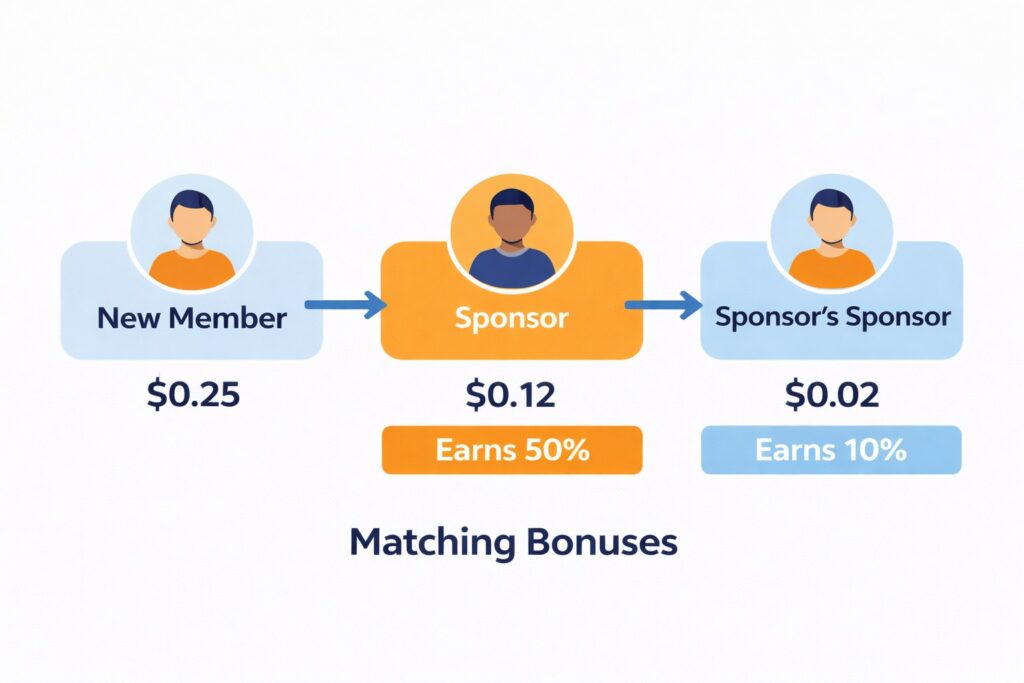
3. Matching Bonuses (Recurring)
Matching bonuses mean:
You earn a percentage of the matrix commissions earned by people you personally enrolled.
Simple example:
If someone you enrolled has 100 active members in their paid levels:
100 × $0.25 = $25 in matrix income
If they are personally enrolled by you, you earn a 50% match:
You earn $12.50 from their activity that month.
If they earn $0.25 from one active member:
You earn approximately $0.12 as a 50% match.
Matching bonuses expand with rank by unlocking deeper generations.
Each generation pays a defined percentage.
Deeper generations pay smaller percentages.
But the concept stays the same:
You earn a portion of what your personally enrolled members earn in matrix commissions.
Money flows upward in layers:
The member generates $0.25
Their enroller earns a percentage match
The next qualified sponsor above them may earn a smaller percentage, depending on rank
Small numbers.
Multiplied across people.
Over time.
This rewards mentorship — not just recruitment.
4. Retail Commissions
LiveGood products have two prices:
- Member price
- Retail price
Most people become members for $9.95 per month and buy at member pricing.
None of this works without product sales.
A compensation plan is only sustainable if people genuinely want the products.
The entire model depends on real customers choosing to buy — not just enrollment activity.
If someone buys at retail price instead of member price, you earn 50% of the difference between those prices at Level 1.
Example:
If a product costs:
- $16 (member price)
- $24 (retail price)
The difference is $8.
50% of $8 = $4 commission
Retail commissions follow the same percentage structure as Fast Start, depending on rank and level.
Unlike Fast Start, retail commissions are earned every time a retail customer places an order.
Customer Acquisition Bonus (One-Time)
When a newly enrolled member places their first product order:
10% of that order volume (up to $300) is paid out as a Customer Acquisition Bonus.
This is a one-time bonus.
What This Really Means
The 2×15 structure is simply a framework.
Income grows as active members fill your paid levels.
There are no volume quotas.
No mandatory purchases.
No monthly sales targets.
Your membership stays active.
The structure does the rest.
Growth can be slow.
Growth can be steady.
Growth can accelerate.
It depends on participation.
That is how the LiveGood compensation plan works — simply, structurally, and without hype.
Small numbers.
Structured correctly.
Multiplied over time.
The structure rewards consistency over hype.
Considering LiveGood?
If you’re evaluating whether this model makes sense for you, take your time.
Read the structure again.
Look at the numbers calmly.
Ask yourself whether you actually like the products.
A compensation plan only works long-term if:
• The products are real
• The pricing makes sense
• The structure is sustainable
If you want to review the official overview directly, you can explore it here.
Yes, the corporate page is enthusiastic. That’s fine.
I prefer my explanations with a little more geometry and a little less confetti — but the structure is the same.
Watch the five-minute video.
Not with starry eyes.
Not with folded arms.
And definitely not because I told you to.
Just watch the structure.
If you’d rather stay here and work through it calmly first, that works too.
No pressure. Just structure.
