We’ve watched network marketers quit seven times before finding their footing. Not an exaggeration – we’ve seen the pattern play out hundreds of times through our softwares. The first company they join? Gone in eight months. The second one switches compensation plans three times before they say forget this. And by company number three, their friends have literally stopped answering calls.
When you build tools that network marketers use every day, you get a front-row seat to everything. The wins. The disasters. The “can’t-miss opportunities” that miss spectacularly. We’ve seen inside thousands of campaigns, watched what actually converts, and listened to more frustrated voice messages from customers than we can count.
So when people ask us how to succeed in network marketing, we don’t give them some polished motivational speech. We give them what actually works, what doesn’t, and why 99 out of 100 people in this industry never make a full-time income. Not because network marketing doesn’t work – it absolutely does – but because nobody tells you the real stuff until you’ve already burned through your warm market and maxed out a credit card.
Look, we’ve been in this industry for over a decade now. We’ve watched companies rise and collapse overnight. We’ve seen distributors making six figures one year and back at their 9-to-5 the next. And we’ve finally figured out what separates the people who build something lasting from everyone else who treats this like a lottery ticket.
This is going to be long. Grab coffee. Actually, grab the whole pot.
Table of Contents
Network Marketing Isn’t What You Think It Is
Quick thing before we dive in – most people fundamentally misunderstand what network marketing actually is. It’s not an industry. It’s a marketing philosophy. That’s it. Just like email marketing, affiliate marketing, or even those annoying TV commercials that promise you’ll suddenly become irresistible if you spray the right cologne.
There are roughly 150 different ways to market a product. Network marketing is just one of them. It means you’re marketing products to your network – your connections, your relationships, your sphere of influence. Multilevel marketing adds layers to this where you can earn from people you’ve introduced to the business who also sell products.
Why do companies choose this model? Simple economics. The cost to acquire a customer is cheaper than running Super Bowl ads. Instead of spending $400,000 on a TV spot that may or may not work, they pay commissions to people who actually make sales. Makes sense on paper.
The problem isn’t the model. The problem is how people execute it.
And honestly? Some of those execution problems are embarrassing. We’ve seen grown adults spray water on strangers’ faces at restaurants to demonstrate product benefits. (True story. The guy got cursed out in three languages.) We’ve watched people pitch their “amazing opportunity” at funerals. Funerals. There’s no coming back from that level of tone-deafness.
So yeah – network marketing has a reputation problem. But is the reputation entirely deserved? Let’s actually break this down.
Why 99% of Network Marketers Fail (And It’s Probably Not What Your Upline Told You)
Okay, hard truth time. Out of 100 people who join a network marketing company, roughly one person makes a livable income. One. And by livable, we mean actually paying bills – $50K, $60K, $80K a year. Not “I made $200 this month” livable.
Your upline probably doesn’t tell you this because, well, it’s terrible for recruiting. But here’s what they also don’t tell you: the failure rate in network marketing isn’t that different from other entrepreneurial ventures.
Real estate? 87% of agents fail within five years, according to industry trainers. Five years of marketing costs, car expenses, time invested – gone. Does that mean real estate doesn’t work? Of course not. Real estate works incredibly well for the people who stick it out and actually develop skills.
Same deal here.
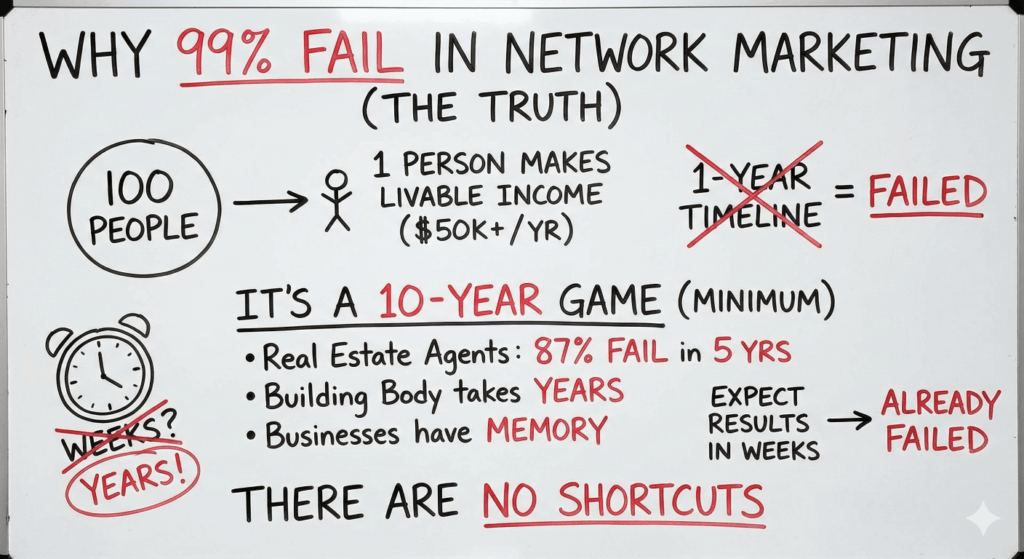
The difference is that network marketing attracts people who expect results in weeks instead of years. And the industry itself feeds that expectation with all the “fire your boss in 90 days” messaging.
We’re going to say something controversial: if you’re giving yourself a one-year timeline to succeed in network marketing, you’ve already failed. Go get a job instead. Seriously. This is a 10-year game minimum. Just like any business.
Building a body takes years. Muscles have memory. Relationships have memory. Businesses have memory. There are no shortcuts that don’t eventually catch up to you.
The Stuff That Gives Network Marketing a Bad Name (And What to Do Instead)
Let’s just put all the problems on the table. If you’re in network marketing, you need to know what behaviors are killing your credibility – often without you realizing it.
The product-hopper problem. We’ve all seen this person. Monday they’re selling juice. By Thursday they’ve discovered the “real” opportunity in essential oils. Next month it’s crypto-backed travel discounts. They pitch every new thing like it’s the one that’ll finally change everything.
It’s exhausting for everyone around them. And it destroys trust.
If you want to know how to succeed in network marketing, here’s rule one: pick something and commit. Your friends will forgive one pitch. Maybe two. By the fifth “revolutionary opportunity,” they’re not even opening your messages anymore.
The inventory garage. This one’s worse than product hopping because it involves real money. New distributors get convinced to buy $5,000 worth of products they’ll “definitely sell” and then watch it collect dust next to the Christmas decorations. We’ve seen people trying to offload stuff on eBay at 90% losses.
If someone’s pressuring you to load up on inventory before you’ve proven you can actually move product, run. That’s not business-building. That’s loading you up so they hit their volume requirements.
The get-rich-quick messaging. Oh man. “Millionaire in 12 months.” “Financial freedom by summer.” “Retire your spouse next quarter.”
Stop. Just stop.

This messaging is why comedians have an endless supply of material about MLMs. When you oversell, you set people up for disappointment. And disappointed people become vocal critics. Forever.
Here’s what’s actually true: network marketing is a ton of work. We’re talking 50, 60, 80 hours a week during the building phase. You’re not going to work a casual 40 hours and wake up wealthy. Anyone who tells you otherwise is either lying or hasn’t built anything themselves.
The compensation-plan-first pitch. Major red flag. If someone approaches you and leads with “who cares about the product, check out this compensation plan!” – that person is one regulatory investigation away from a lot of problems.
Product first. Always. You need to genuinely believe in what you’re selling. Because when hard times come (and they will), the only thing keeping you going is actual belief in what you’re putting into people’s hands.
We’ve failed at selling things we didn’t believe in. The energy just isn’t there. You can fake enthusiasm for maybe a month before it becomes obvious to everyone.
The Pyramid Scheme vs. Legitimate Network Marketing Thing (Let’s Finally Clear This Up)
Every time someone mentions network marketing, some genius in the room mutters “pyramid scheme” like they’ve cracked a secret code. So let’s actually define terms here because the confusion is getting ridiculous.
Pyramid scheme: No real product exists. Money just moves from new recruits to people above them. Eventually the math collapses and everyone except the people at the very top loses everything. These are illegal. People go to prison for running them – and they should.
Ponzi scheme: Named after Charles Ponzi, an Italian businessman from the 1920s who promised people huge returns on investments. No actual investing was happening – he was just paying early investors with money from later investors. Bernie Madoff ran a Ponzi scheme for decades. Prison.
Network marketing: Actual products exist that actual consumers want to buy. Distributors earn commissions on sales. Yes, there are levels. But the product is the product.
Companies like Amway, Herbalife, Mary Kay – they’ve been around for decades. If they were pyramid schemes, they’d be shut down. You don’t see David Beckham wearing logos for illegal operations on his jersey. The Orlando Magic don’t play in arenas named after con artists.
Does network marketing have companies that operate in gray areas? Absolutely. We’ve seen some compensation plans that felt more like musical chairs than business models. But the existence of bad actors doesn’t invalidate an entire marketing philosophy.
Quick side note – there was a company years back called 2×2.net where you’d literally just buy “positions.” People were rolling around in Lamborghinis with company stickers on them. Attorney General shut it down. Everyone knew it was coming except, apparently, the people in Lamborghinis.
Pay attention to whether real product is moving to real customers who actually want it. That’s your test.
What Actually Works: The Stuff Nobody Wants to Talk About
Okay, enough about what’s wrong with the industry. Let’s talk about how to succeed in network marketing if you’re actually committed to making this work.
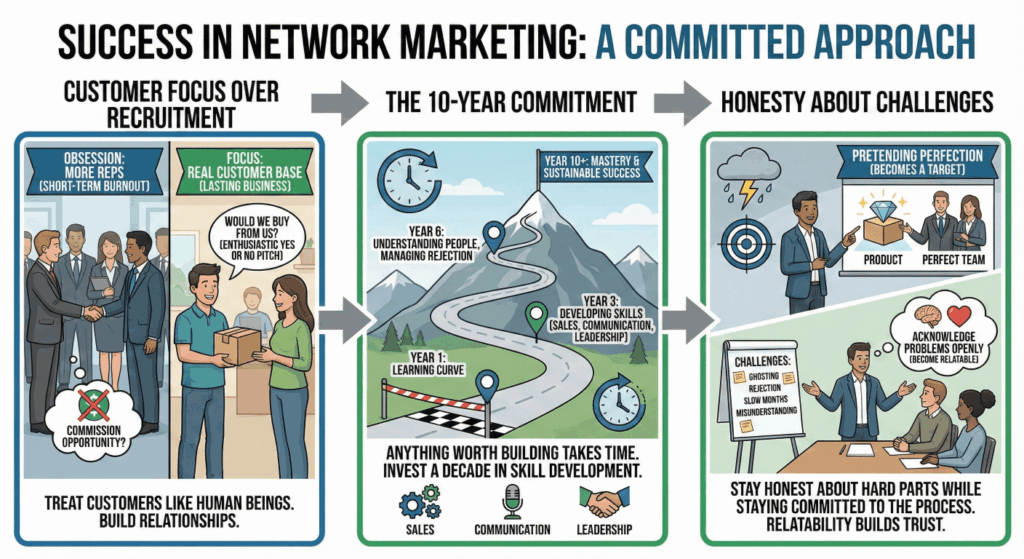
Customer focus over recruitment obsession. This is the single biggest shift that separates people who build lasting businesses from people who burn out in 18 months.
Most network marketers focus almost exclusively on recruiting. More reps, more reps, more reps. And they completely ignore the customers – you know, the people actually buying products?
Here’s a question we ask ourselves before every sale: if we were this person, would we buy from us? If the answer isn’t an enthusiastic yes, we don’t make the pitch. Period.
Treating customers like human beings instead of commission opportunities sounds obvious. But go attend any network marketing meeting and count how many times “customer service” gets mentioned versus “building your downline.” It’s not close.
The companies that last – the 20-year, 30-year companies – are the ones with real customer bases. Not just distributors buying enough product to stay active in the compensation plan.
The 10-year commitment. We mentioned this earlier but it’s worth hammering home. If you’re not willing to commit 10 years to building something, network marketing probably isn’t for you.
That sounds harsh. We know. But think about it – would you expect to become a successful lawyer in one year? A skilled surgeon? A master craftsman?
Anything worth building takes time. The people who’ve made real money in network marketing – the people who actually drive nice cars because they earned them, not because they’re financing them to look successful – put in a decade or more.
We’re talking about building skills here. Sales skills. Leadership skills. Communication skills. Understanding people. Managing rejection. These don’t develop overnight no matter how many motivational podcasts you consume.
Stop painting everything as perfect. This is huge. Network marketing gets targeted by critics so effectively because people in the industry present everything as flawless. The products are perfect. The opportunity is perfect. The company is perfect. The culture is perfect.
Nothing is perfect. Your marriage isn’t perfect. Your health isn’t perfect. Your business won’t be perfect either.
When you acknowledge problems openly, you become relatable. When you pretend problems don’t exist, you become a target. Simple as that.
We tell people straight up: this business has challenges. There will be months where nothing seems to work. You’ll have people ghost you after seeming excited. Your family might think you’ve joined a cult. That’s all part of it.
The people who succeed aren’t the ones with the smoothest pitches. They’re the ones who stay honest about the hard parts while staying committed to the process.
How to Choose a Company (If You’re Going to Do This)
Alright, practical stuff. If you’re actually considering network marketing, here’s what we’d be looking at:
A product you’d buy anyway. Seriously. Would you use this product if there was no compensation plan attached? If the answer is no, you’re already starting from a losing position.
We know people who joined companies selling products they secretly thought were overpriced or ineffective. Their careers lasted about as long as you’d expect. You can’t fake enthusiasm for something you don’t believe in.
Company timing matters more than you think. Companies go through phases:
- Survival (first two years): 95% of new companies don’t make it past this phase. Unless you really know what you’re doing and can handle massive uncertainty, avoid.
- Formulation (years 2-7): Things are stabilizing. Systems are being built. This is risky but can offer significant upside if the company’s fundamentals are solid.
- Explosion (years 7-15): This is where real momentum happens. The company has proven it can survive. Growth accelerates.
- Plateau (15+ years): The explosive growth phase is over. You can still build here, but you’re not catching the wave – you’re joining established infrastructure.
None of these are wrong choices. It depends on your risk tolerance and goals. Just know what phase you’re entering.
Compensation plan longevity. Some companies offer compensation plans that look amazing on paper but aren’t sustainable. If the company is paying out 70% of revenue in commissions, something’s going to break eventually.
The company needs to profit for you to have something to build on. A comp plan that’s too good probably won’t exist in three years.
We always ask: has this compensation plan been stable for at least five years? Companies that keep restructuring their comp plans are essentially pulling the rug out from under their distributors.
Culture and leadership. You’re going to spend more time with your team than with your family during building phases. You’d better like these people.
Do the leaders at the top share your values? Are they stable? Have they been with the company for years or do they hop around constantly? Is the culture supportive or cutthroat?
One dinner with leadership can tell you everything you need to know. Watch how they treat servers at restaurants. Watch how they talk about struggling distributors. You’ll learn more in two hours of observation than in twenty hours of company presentations.
A worthy cause. This sounds soft, but it matters. Companies with authentic missions attract people who stick around. Companies built entirely around making money tend to cycle through distributors constantly.
You can tell when leadership actually believes in what they’re building versus when they’re just chasing market trends. The authentic ones talk about their mission constantly and have deep personal stories about why it matters to them. The fake ones mention it once in their presentation and move on to compensation details.
The Compensation Plan Types (And What We Actually Think About Them)
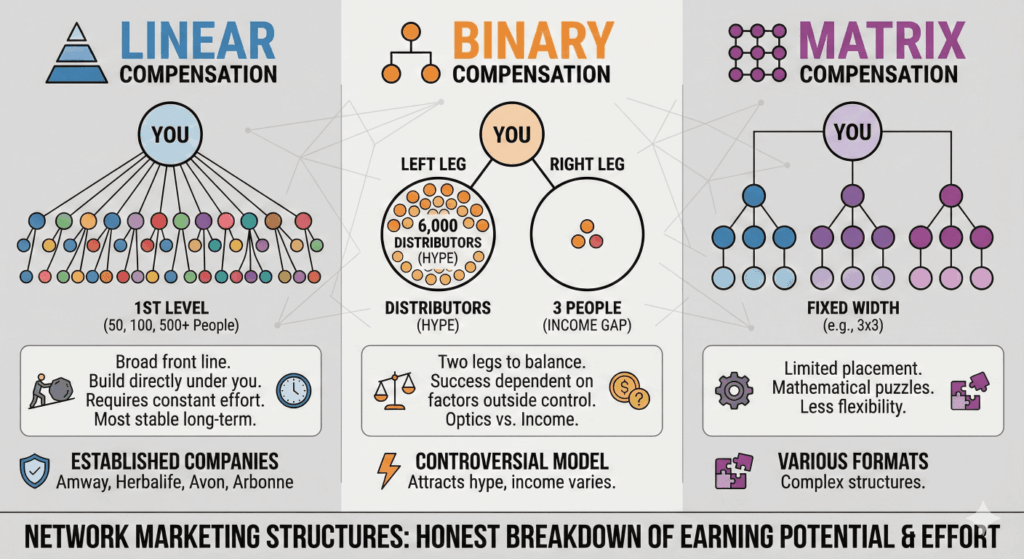
There are basically three main compensation structures in network marketing. Let’s break them down honestly.
Linear (what most established companies use): You recruit directly under you. You can have 50, 100, 500 people directly in your first level. If you stop working, you can get passed up by more productive people. It requires constant effort but builds the most stable long-term businesses.
Amway, Herbalife, Avon, Arbonne – these are linear companies. They’ve been around for decades. There’s a reason for that.
Binary (the controversial one): You build two legs – left and right. You need to keep them balanced to earn commissions. Sounds simple until you realize your success is dependent on factors you can’t fully control.
We’ve seen people with 6,000 distributors on one leg making almost nothing because their other leg has three people (all cousins who barely use the product). The optics look great but the income doesn’t follow.
Binary tends to attract more hype because people can show impressive team sizes. But team size and actual income are very different metrics.
Matrix (various formats): Fixed-width structures that limit how many people you can place in each level. These can work but often feel more like mathematical puzzles than business-building.
Our honest take? Linear takes more work but creates more stable, lasting income. Binary can create faster initial results but tends to be more fragile. Matrix depends heavily on specific implementation.
Managing Your Finances (Because Nobody Talks About This Part)
Here’s something your upline almost definitely won’t teach you: financial management.
Network marketing can create real income. It can also create tax nightmares if you don’t know what you’re doing.
We’ve watched people make their first $100K in network marketing and immediately buy a BMW they couldn’t actually afford. Then the company had issues, their income dropped, they owed the IRS quarterly taxes they hadn’t been paying, and suddenly they couldn’t even get approved for apartment leases because of the liens.
If you’re building income in network marketing:
- Pay quarterly estimated taxes. Do not wait until April. The IRS doesn’t care that you “didn’t know.”
- Build savings before buying things. We tell our team to have at least six months of expenses saved before upgrading their lifestyle.
- Understand that business expenses are deductible. But buying fancy things to “look successful” isn’t a business strategy – it’s a debt strategy.
- Get an accountant who understands self-employment income. Your cousin who does taxes for W-2 workers isn’t equipped for this.
The tax benefits of running a business are real. But only if you actually manage them instead of treating every commission check as play money.
Social Media: There’s a Right Way and a Wrong Way
We have to talk about this because it’s where most network marketers completely destroy their credibility.
The wrong way: copy-pasting the same link to everyone in your contacts list without even reading their profile first. Mass-messaging people you haven’t talked to since middle school with “hey hun, I have an amazing opportunity!” Adding people to groups without their permission. Posting income screenshots every day.
We got a message once from someone whose script was so obviously templated that they accidentally left the placeholder text in: “Hi [NAME], I’ve been following your journey and…”
They didn’t even bother to fill in our name. That’s not marketing. That’s spam with a smiley face.
The right way: actually building relationships. Providing value before asking for anything. Being a real person with interests and opinions beyond your business. Engaging with people’s content genuinely. Taking time to understand someone’s situation before recommending anything.
Social media gives you access to unlimited potential connections. But access isn’t the same as trust. Trust is earned through consistent, authentic interaction over time.
If your entire online presence is product photos and income testimonials, you’re not building relationships. You’re building a wall that people will eventually stop trying to see past.
The Real Reason Network Marketing Works (When It Works)
We’ve thrown a lot of criticism at this industry. Probably more than you expected from people who’ve actually built businesses in it. But here’s what’s also true:
Network marketing actually works. The Direct Selling Association reports this is a $35+ billion annual industry. It’s created real wealth for people who would never have had those opportunities through traditional paths.
We know people who escaped poverty through network marketing. Single parents who built flexibility and income simultaneously. People without college degrees who out-earn their peers with MBAs. Immigrants who found communities and mentorship that accelerated their understanding of business.
Mary Kay changed lives. Amway created generational wealth. Art Williams built something that people still talk about with emotion decades later.
When people who worked directly with these leaders talk about them, they get emotional. “This person changed my life” isn’t an exaggeration – it’s lived experience for thousands of people.
The industry has problems. Real ones. But dismissing it entirely ignores the actual results for people who approach it correctly.
Now What? Actually Implementing This
If you’ve made it this far, you’re either really interested in network marketing or really committed to procrastinating on something else. Either way, here’s what we’d suggest for next steps:
Already in a company? Audit yourself honestly. Are you focused on customers or just recruitment? Are you treating this like a 10-year commitment or expecting overnight results? Have you actually used and believe in your products? Are you managing your finances or just spending commissions?
Considering joining? Slow down. Research companies thoroughly. Ask about compensation plan stability. Talk to people who’ve been in for five or more years, not just the newest success stories. Check if the product would exist without a compensation plan attached.
Decided it’s not for you? That’s completely fine. Network marketing isn’t for everyone. Neither is law school, or starting a restaurant, or becoming a professional athlete. Finding out what doesn’t fit is just as valuable as finding what does.
For those who are building or want to build in this industry – keep going. Stay honest about the challenges. Focus on customers. Think in decades, not days. And for the love of everything, stop spraying strangers with water at restaurants.
The Badass Network community has more resources for people who want to build sustainable network marketing businesses the right way. No hype. No fake promises. Just what actually works from people who’ve actually built it.
And if you have questions after reading all three thousand plus words of this – yeah, we’ll answer them. That’s what we’re here for.
What’s your experience been with network marketing? Hit us in the comments – we read every single one. Even the ones calling us out. Especially those, honestly.
I really appreciate this article – it unpacked many of the issues in the network marketing industry really concisely! The initial scramble, the annoying posting, the focus on recruitment – all of these I am guilty of. Time is the healer, thankfully. Slowing down, taking stock, making sure that my values, my core beliefs are actually aligned with what I am saying. And I have found that they very much are when I focus on the long-term vision, the type of ‘recruiting’ that is brutally honest, conservative rather than hyped up and I show up with authenticity.
My first 5 months in LiveGood have not been wasted, the learning has been intense and important – because now I get to lead my team with the values that I represent and I have my path in front of me, mapped out by the ‘mistakes’ I made. I can guide those who join my team with a deep understanding of what is crap and what is good.
And you are spot on about the product of any network marketing company needing to be your absolute focus. If people don’t buy them because they are awesome, the whole company comes tumbling down.
Thank you for your excellent research. I am new to blogs and you have just set the bar fairly high….always challenging me!!
Thanks for your kind words Dominique! Glad they’ve been of help – remember: it’s never a waste when you’ve learned something! 🙂
Nothing ventured, nothing gained or however the saying goes. All the things I have tried and tested and failed at and picked up again – they are what builds a solid foundation for my business to grow. 2026 will be much less poke in the dark and much more aligned to my vision. Goggles are on, helmet is ready and there’s always the emergency parachute if shit hits the fan 🙂
This was super insightful. Thanks for this. I have to say, you’re right binary and matrix are so chaotic. Recently after exploring lots of comp plans, the only ones that made any sense were the linear. You recruit people and earn from their recruits many levels down. Spillover and such is useless when you have to play the marching game of, x amount on one leg and x amount on the other or else you don’t get paid.
Glad you agree with us Mark. It all sounds cool till it’s not 😛 😉