We deleted our first blog. The whole thing. Six months of work – gone.
Looking back, it was the smartest thing we ever did. That blog was a mess. No focus. No strategy. Just two people throwing content at the wall hoping something would stick. Nothing did.
But here’s what that failure taught us about how to start a blog and make money: most of the advice out there is either outdated, overcomplicated, or written by people who’ve never actually built a profitable blog themselves. They tell you to “find your passion” and “be consistent” like that’s some kind of revolutionary wisdom.
So we started over. Built something different. And now we run Badass Network, helping bloggers like yourself skip the painful learning curve we went through.
This guide is everything we wish someone had told us back then. No fluff. No filler. Just the stuff that actually moves the needle when you’re trying to turn a blog into real income.
Table of Contents
The “Pick Your Niche” Advice Everyone Gets Wrong
Okay, let’s start with the thing every blogging guide tells you first: choose your niche.
But nobody explains what that actually means in practice. They say “follow your passion” or “write what you know” and leave it at that. Terrible advice. Passion doesn’t pay bills. Neither does expertise – unless people are willing to spend money in that space.
We’ve seen bloggers pour their hearts into topics nobody’s searching for. Beautiful content. Genuinely helpful stuff. Zero traffic. Zero income.
Your niche needs three things working together:
Something you can actually write about for years. Not just topics you find interesting today, but subjects you won’t hate in 18 months when you’re grinding out your 200th post. We know a food blogger who loved cooking until she had to photograph every single meal she made. Burned out in eight months.
Proof that people are spending money there. Look for affiliate programmes, courses, products, services. If companies are advertising in a space, there’s money flowing. Simple as that.
Room for your angle. You don’t need to invent a new niche. You need a fresh perspective on an existing one. “Personal finance” is saturated. “Personal finance for freelance designers” has breathing room.

Quick exercise: open Amazon and search topics you’re considering. Look at books with hundreds of reviews. Those exist because people are actively trying to solve problems in that space. Problems they’ll pay to fix.
We spent three weeks on niche research before starting Badass Network. Felt like forever at the time. Saved us years of wasted effort.
How Blogs Actually Make Money (The Honest Version)
Before you set anything up, you need to understand the money side. Not the fairy tale version where you write a few posts and passive income starts flowing. The real version.
Affiliate marketing is usually where beginners start. You recommend products, include special tracking links, and earn a commission when someone buys. Commission rates vary wildly – Amazon pays around 3-4% on most stuff, while software and course affiliates might pay 30-50%. Some programmes pay recurring commissions, which is where it gets interesting. Our affiliate program helps you earn 40% recurring commission for example.Our affiliate program helps you earn 40% recurring affiliate commission for example. One referral can pay you monthly for years!
Display advertising means putting ads on your site through networks like Google AdSense or (once you’re bigger) Mediavine or AdThrive. The money is directly tied to traffic – more visitors, more ad views, more income. New bloggers might earn €2-5 per thousand visitors. Established sites in good niches can hit €25-40 or higher.
Digital products are where serious bloggers eventually land. Ebooks, courses, templates, printables. You create once, sell forever. Margins are insane compared to everything else – no inventory, no shipping, no middleman taking a cut.
Services leverage your blog as a portfolio. Coaching, consulting, freelancing. Your content proves you know what you’re talking about. Clients come to you instead of you chasing them.
Sponsored content comes later, once you have traffic and an engaged audience. Brands pay you to write about their products. Can be lucrative but requires careful balance – too much sponsored stuff and you lose reader trust.
Now here’s what nobody tells you about timelines.
Months 1-6? You’re probably making nothing. Maybe a few euros from random affiliate clicks. This is where most people quit.
Months 6-12? If you’re doing things right, you might see €100-500/month trickling in. Enough to cover your hosting. Maybe.
Year 2+? This is when things can actually take off. We’ve seen bloggers in our community go from €500 to €5,000/month in a single year once momentum kicks in.
The bloggers who make real money aren’t necessarily better writers. They just didn’t quit during the ugly early phase.
Setting Up Your Blog Without Losing Your Mind
Right. Technical stuff. This is where a lot of beginners either overcomplicate everything or make choices they’ll regret.
Platform choice matters more than you think.
Free platforms like WordPress.com, Wix, or Blogger seem attractive when you’re starting. No cost, easy setup, what’s not to love?
Everything, honestly.
Free platforms limit what you can do. Want to add affiliate links? Some don’t allow it. Want to customize your design? You’ll hit walls. Want to run your own ads? Nope. And worst of all – you don’t really own your site. Break their terms of service (sometimes accidentally) and your blog disappears.
Self-hosted WordPress gives you full control. Your site, your rules. But it comes with headaches: hosting to manage, security updates to run, plugins to maintain, technical issues to troubleshoot at 2am when something breaks.
There’s a third option most guides don’t mention.
Join an established network that handles the technical stuff while you focus on content.
This is actually why we built Badass Network. We got tired of helping new bloggers troubleshoot hosting problems when they should’ve been writing. Our members get a WordPress blog on our domain – all the flexibility of WordPress without the backend nightmares.
But the real advantage is SEO.

New domains have zero authority with Google. You’re starting from nothing. Content that would rank on an established site just… doesn’t. You’re invisible for months, sometimes years.
When you blog on a domain that already has authority and history, your content has a fighting chance from day one. We’ve seen members rank for competitive keywords within weeks. On a fresh domain? That same content might take a year.
Whatever you choose, here’s the minimum you need:
- A clean, fast theme (nothing fancy – speed matters more than aesthetics)
- Basic pages: About, Contact, Privacy Policy
- Google Analytics set up (you need to track what’s working)
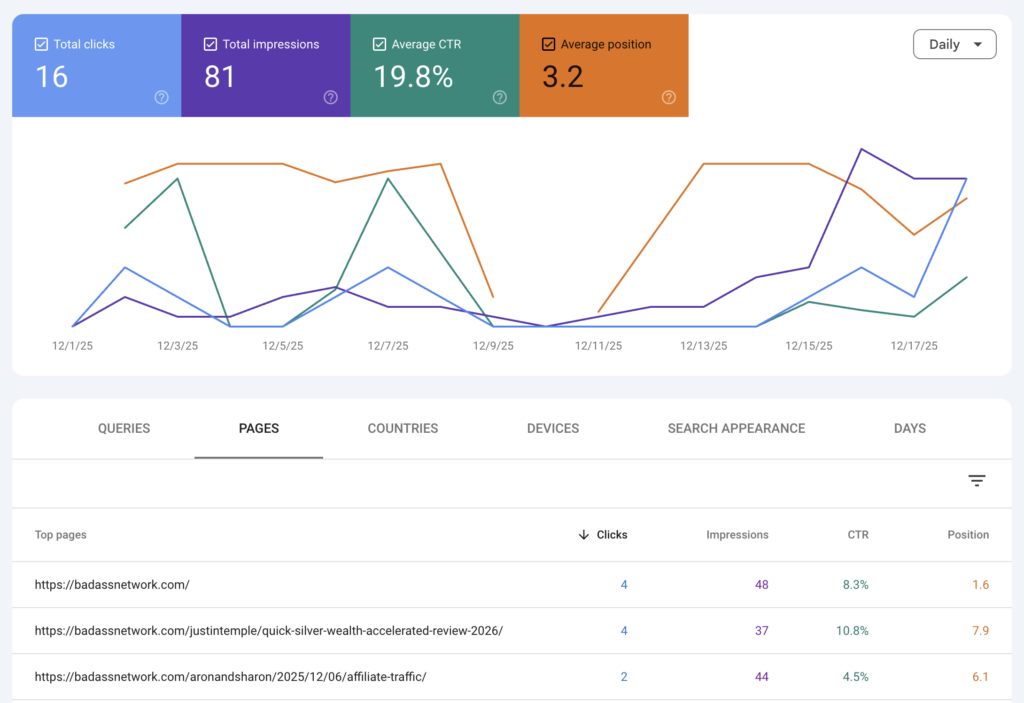
- Google Search Console connected (this shows you what keywords you’re appearing for)
- A backup system (we’ve seen bloggers lose everything – don’t be that person)
Side note: don’t spend three weeks picking the perfect theme. Seriously. Pick something clean, start writing. You can always change it later.
Creating Content That Doesn’t Disappear Into the Void
Most blog posts get zero traffic. We’re not exaggerating. The vast majority of content published online is never seen by anyone except the person who wrote it and maybe their spouse who felt obligated to read it.
So what separates content that ranks from content that vanishes?
Keyword research. Always.
This feels boring and technical, but skip it and you’re guessing. You need to know what people are actually typing into Google.
Start with free tools. Google’s “People Also Ask” boxes are gold. Type your topic, see what questions come up. Ubersuggest has a free tier. AnswerThePublic visualizes questions around any topic.
Look for long-tail keywords – longer, more specific phrases. “How to train a puppy” has massive competition. “How to train a stubborn beagle puppy to walk on leash” has way less.
Check who’s ranking for terms you’re considering. If page one is dominated by huge sites like Forbes, WebMD, or Wikipedia – pick a different battle. Find keywords where smaller blogs are ranking. That’s your opening.
Structure matters more than beautiful writing.
People scan blog posts. They don’t read every word. (You’re probably scanning this right now. That’s fine. We get it.)
Use headers to break up content. Write short paragraphs. One-sentence paragraphs are completely fine. Use bullet points for lists. Bold important phrases.
Make your post scannable and you’ll keep people on the page longer. Keep people on the page longer and Google notices. Google notices and you rank higher. Virtuous cycle.
Write for humans first, algorithms second.
We’ve seen bloggers stuff so many keywords into their posts that the content becomes unreadable. Google’s smarter than that now. Write naturally. Use your keyword and variations of it, but don’t force it.
The best SEO advice we ever got: write something so helpful that people would bookmark it, share it, or reference it later. If your content genuinely helps someone, the technical SEO stuff becomes easier.
Update old content.
This is huge and almost nobody talks about it.
A post that’s ranking okay at position 15 might jump to position 5 with a solid update. Refresh statistics, add new sections, improve the formatting. Google loves seeing content that stays current.
We update our top posts every 6-12 months. Some of them have been rewritten three or four times. Each update usually brings a traffic bump.
The Email List You Should’ve Started Yesterday
If we could go back and change one thing from our early blogging days, it’s this: we would have started building an email list from day one.
Not week one. Not once we had traffic. Day. One.
Social media algorithms change. Google updates can tank your rankings overnight. But your email list? That’s yours. No algorithm can take it away.
The bloggers making serious money? They all have lists. Usually big ones. We know a blogger pulling €15,000/month from a list of 40,000 subscribers. Another making €8,000/month from just 12,000 – but they’re hyper-engaged subscribers in a profitable niche.
Start with a lead magnet.
Nobody subscribes to “get updates” anymore. You need to offer something valuable in exchange for that email address.
Checklists work. Templates work. Short guides work. A free chapter of an ebook works. Resource lists work.
Whatever you create, make sure it directly relates to your content. A weight loss blog offering a “free budgeting spreadsheet” makes no sense. Match the magnet to the content that leads people to it.
Email platforms for beginners:
ConvertKit is what a lot of bloggers use. Free up to 1,000 subscribers. Mailchimp has a free tier too. MailerLite is solid. Don’t overthink this – pick one and start.
What to send:
New post notifications. Helpful tips related to your niche. Personal stories that build connection. Occasional recommendations (with affiliate links, if relevant).
Don’t email just to email. Every message should provide value or entertainment or both. Train your subscribers to open your emails because they’re actually worth reading.
Getting Eyeballs on Your Blog (Without Paying for Ads)
You’ve got your blog set up. You’re creating content. Now what?
Waiting for Google to notice you isn’t a strategy. Especially in your first year, you need to actively drive traffic while your SEO builds.
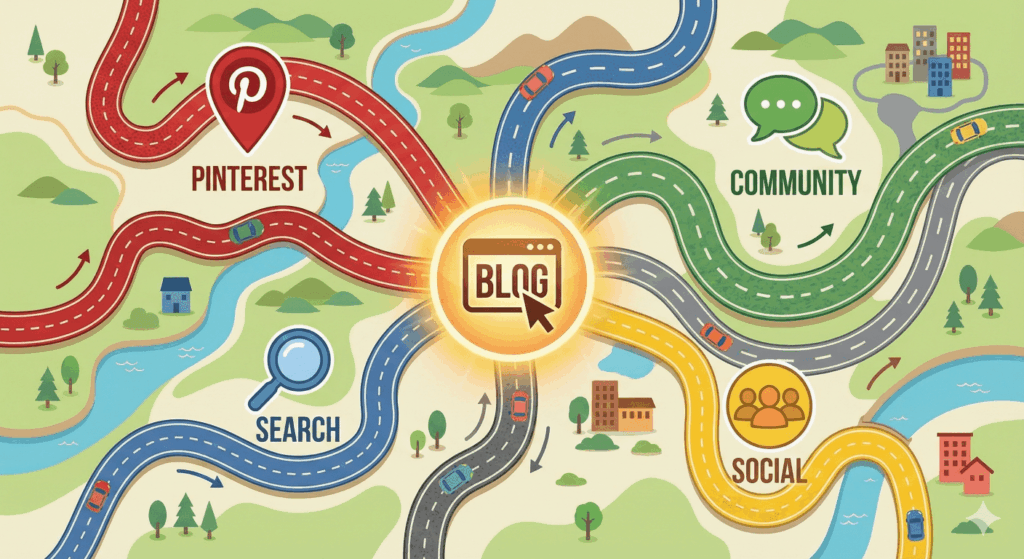
Pinterest is still weirdly powerful for bloggers.
We know, we know. Pinterest feels like it’s for recipes and home decor. But it’s actually a search engine disguised as a social platform. And it can send serious traffic.
Create pins for your posts. Use keywords in pin descriptions. Join group boards in your niche. Be consistent – Pinterest rewards regular activity.
Some niches crush it on Pinterest: food, DIY, personal finance, parenting, travel, health, home organization. Others… not so much. Tech and B2B? Probably skip it.
Guest posting still works.
Find blogs in your niche that accept guest posts. Write something genuinely good for them. Include a link back to your site in your author bio.
This does two things: sends referral traffic and builds backlinks (which help SEO). One solid guest post on a respected site can outperform months of posting on your own blog.
Community participation.
Facebook groups. Reddit. Quora. Forums in your niche.
Don’t spam your links everywhere – that gets you banned and makes you look desperate. Actually participate. Answer questions. Be helpful. Drop your link only when it’s genuinely relevant.
People click through to check out bloggers who consistently provide value in communities. They don’t click through for obvious self-promoters.
The network effect.
This is something we’ve seen work incredibly well within Badass Network. When you’re part of a community of bloggers, you can cross-promote. Share each other’s content. Link to each other’s posts. Comment on each other’s articles.
Google sees this activity. Readers discover you through other bloggers they trust. Everyone benefits.
Solo blogging is hard. Community blogging compounds your efforts.
Monetisation: When and How to Start (a blog) and Make Money
Alright, let’s talk about actually getting paid.
Don’t monetise too early.
We see new bloggers slapping ads all over sites with 100 monthly visitors. It earns them literally cents while making their site look cluttered and slow.
Our suggestion: wait until you’re getting at least 1,000-2,000 monthly visitors before adding display ads. Focus on growth first.
Affiliate links are different. You can add those from day one, as long as they’re genuinely relevant to your content. Just don’t go overboard – a post with seventeen affiliate links screams desperation.
Affiliate marketing strategy that actually works:
Write content around problems your target audience is trying to solve. Within that content, recommend products that help solve those problems. That’s it. That’s the whole strategy.
“Best email marketing tools for food bloggers” targets a specific audience with a specific problem. Review the tools honestly, include pros and cons, add your affiliate links. When someone’s ready to buy, they buy through your link.
Product reviews, comparison posts, “how to” tutorials featuring specific tools – these convert better than random link-dropping.
Recurring commissions are the goal.
One-time commissions are fine. Recurring commissions are better.
When you refer someone to a subscription product and earn commission every month they remain a customer? That adds up fast. We’ve built recurring income streams that pay us for referrals we made three years ago.
At Badass Network, our affiliate programme pays 40% recurring. Refer five people, earn €50/month every month they stay. Refer fifty people, earn €500/month. You get the idea.
Look for recurring commission programmes in your niche. Software, memberships, subscription boxes – anything with ongoing payments.
Digital products when you’re ready.
Once you understand your audience, you can create products that serve them.
What questions do you get asked repeatedly? What problems do your readers struggle with? Package solutions into ebooks, courses, or templates.
Pricing tip: new bloggers often price too low. A comprehensive course solving a real problem can sell for €97, €197, even €497. An ebook that took you months to write shouldn’t be €4.99.
Start with something small – a template pack or short guide for €17-27. Get comfortable selling. Then work up to bigger products.
The Mistakes That Kill New Blogs (And How to Dodge Them)
Quick thing – we want to cover the traps we see bloggers fall into constantly. Avoiding these will put you ahead of 90% of people who try blogging.
Going too broad.
“Lifestyle” isn’t a niche. Neither is “business” or “health.” You can’t compete with everyone writing about everything. Narrow down until it feels almost too specific. You can always expand later.
Expecting quick results.
Blogging is a slow game. If you need money next month, get a part-time job. Blogging income typically takes 12-24 months to become significant. Anyone telling you otherwise is selling something.
Ignoring SEO until later.
Learning SEO basics now saves you from rewriting hundreds of posts later. We know bloggers who had to go back and optimise 300+ articles because they ignored keywords early on. Learn it right from the start.
Not building an email list.
Already covered this, but it bears repeating. Start immediately. Even if it grows slowly.
Trying to do everything alone.
Solo blogging burns people out. Join communities. Get feedback. Learn from others. Ask questions. Having people who understand what you’re going through makes the hard parts bearable.
Posting inconsistently.
Google likes sites that publish regularly. Readers like sites they can depend on. Pick a schedule you can maintain and stick to it. Two posts per week is better than five posts one week and nothing for a month.
Chasing perfection.
Your first posts won’t be your best. That’s fine. Publish them anyway. You can always update later. Bloggers who wait for perfection never publish.

The Fast Track: Why Some Bloggers Succeed Faster
Okay, real talk. Some bloggers hit profitability in their first year. Others struggle for three years and never get there. What’s the difference?
It’s usually not talent. It’s definitely not luck.
The bloggers who succeed faster almost always have one or more of these:
They’re building on existing authority. Starting on a fresh domain with zero backlinks and zero history is playing on hard mode. Building within a network that already has domain authority is a massive shortcut. Your content can actually rank while you’re still new.
They’re learning from people who’ve done it. Not YouTube videos. Not random blog posts. Actual communities where they get feedback, ask questions, and see what’s working right now. Strategies that worked in 2020 often don’t work in 2026. You need current information.
They’re diversifying income streams early. Not putting all their eggs in the “Google traffic → ads” basket. Building email lists, creating affiliate relationships, thinking about products from the beginning.
They have support systems. Someone to tell them their post is confusing. Someone to celebrate when they get their first sale. Someone to talk them off the ledge when traffic tanks for no apparent reason.
This is honestly why we built what we built. We wanted to give new bloggers the advantages we didn’t have – the SEO head start, the community support, the clear path to monetisation.
For €25/month, Badass Network members get:
- A customisable blog on our established domain (immediate SEO benefit)
- Access to our private community (education, feedback, support)
- A 40% recurring affiliate programme (built-in income opportunity)
- No technical headaches (we handle hosting, security, updates)
Not everyone needs this. If you want complete control and don’t mind the technical work and slow SEO build, go the self-hosted route. Plenty of successful bloggers do.
But if you want to focus on creating content and building income without the backend hassles? Check out what we’ve built: https://badassnetwork.com
Your First 90 Days: A Realistic Action Plan
Let’s make this practical. Here’s what we’d do if we were starting from zero today.
Days 1-7: Foundation
- Finalise your niche (don’t rush this)
- Set up your blog (join Badass Network or go self-hosted)
- Create essential pages (About, Contact, Privacy)
- Set up Google Analytics and Search Console
- Choose an email platform and create a simple lead magnet
Days 8-30: Content Creation
- Research 10-15 keywords you want to target
- Publish your first 4-6 posts (aim for 1,500+ words, genuinely helpful)
- Set up email opt-in forms on your site
- Create Pinterest account if your niche fits
Days 31-60: Traffic Building
- Continue publishing (at least 2 posts per week)
- Start Pinterest strategy (if applicable)
- Join 2-3 communities in your niche
- Reach out to 3-5 sites about guest posting
- Add relevant affiliate links to existing content
Days 61-90: Monetisation Setup
- Apply to affiliate programmes in your niche
- Add more affiliate links strategically
- Create a second lead magnet
- Consider display ads if traffic warrants it
- Review analytics – what’s working? Do more of that.
Track these 4 milestones:
- First 1,000 site visitors
- First 100 email subscribers
- First affiliate commission
- First page-one ranking
These feel tiny. They’re not. Every successful blogger hit these milestones once. Then kept going.
Okay, Now Actually Start
Look, we could keep writing. There’s always more to cover – we didn’t even get into link building strategy, or content repurposing, or analytics deep dives. Maybe those are future posts.
But honestly? You probably have enough information now to begin. More information won’t help if you don’t act on what you already know.
The bloggers making money aren’t smarter than you. They just started. Then they kept going when it got hard. Then they kept going a little longer.
Most people never start. Of those who do, most quit within six months. If you’re still publishing after a year, you’re already in the top 10% of people who try this.
So start. Today, if possible.
Got questions? Drop them in the comments. We read everything.
Or come join us at Badass Network – we’d love to help you build something that actually makes money.